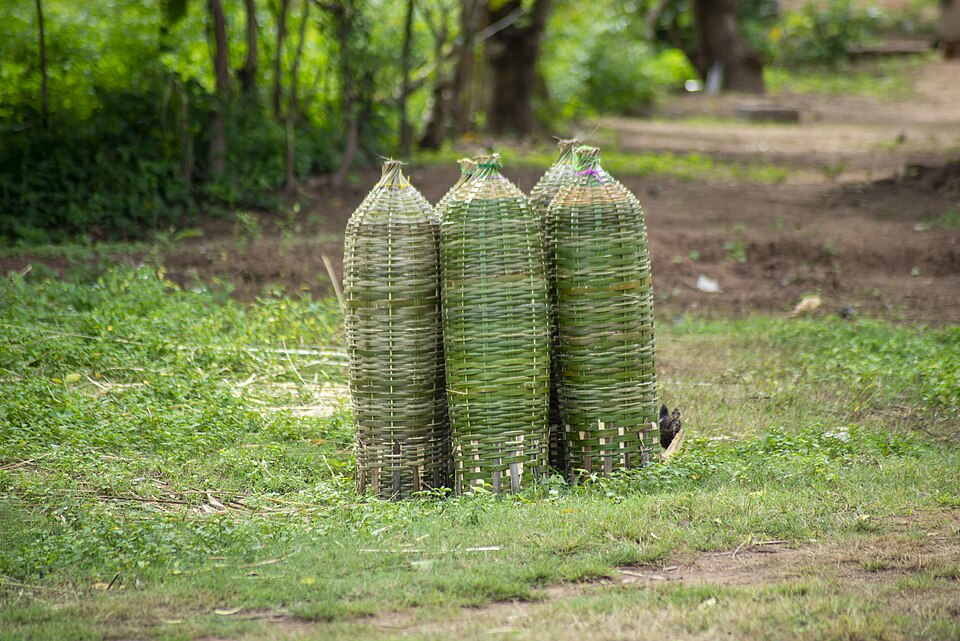
 Photo: Amuzujoe · CC BY-SA 4.0 · source ↗

Bamboo fish traps
Bamboo fish traps are a family of passive inland capture-fishery gears made of slit bamboo, used across India and South Asia for catching fish, prawns and eels in rivers, beels and paddy-fed channels. They are typically operated by fisherfolk and pond-side farmers to harvest by-catch, control predator species, or remove wild fish before pond preparation.
Function
The traps work by funnelling fish through a one-way opening into a holding chamber from which escape is mechanically obstructed. Different shapes target different species: conical pencil-sleeve traps for eels and small fish, large cylindrical one-way-door traps for major carps such as rohu and catla (see Carp Polyculture Pond), and rectangular basket traps for catfish.
Design and specifications
ICAR-CIFT (Central Institute of Fisheries Technology) field surveys in the Brahmaputra valley alone identified 28 distinct trap types, grouped into five categories by principle of capture, design and method of operation. Almost all forms use slit bamboo as the structural material, tied together with cotton or nylon thread. Traps are weighted with stone or floated with thermocol to position them at the desired water column. Typical service life is 2-3 years before bamboo degrades.
Operation
Traps are usually set across slow-flowing channels, between pond bunds, or in flooded paddy fields, often baited with rice bran or other locally available attractants. They are checked at dawn or dusk depending on the target species.
Adoption context
Bamboo traps remain part of the traditional ecological knowledge documented by CIFT and state fisheries departments. In modern aquaculture, they are used alongside engineered gear for stock checks and to clear unwanted species before stocking certified fingerlings (see Fingerling Seed Quality); fully drainable pond design (see Fish Pond Construction) reduces dependence on traps for final harvest.
Related entries
See also: Carp Polyculture Pond, Murrel Korameenu Farming, Fish Pond Construction, Fingerling Seed Quality.
References
- Traditional fish trapping devices and methods in the Brahmaputra valley. ICAR-CIFT.
- Fish trapping devices and methods in Assam - A review. Indian Journal of Fisheries.
- Traditional fishing gears of Birbhum District, West Bengal. Indian Journal of Traditional Knowledge.