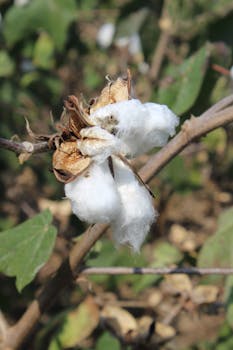
 Photo: Shree_clips B · Pexels License · source ↗
Cotton recovery from herbicide phytotoxicity
Cotton can recover from mild post-emergence herbicide injury once new leaves emerge from undamaged meristems, but recovery is accelerated by foliar biostimulants, nutrient correction and a return to favourable growing conditions. The practice is most relevant after directed sprays of pyrithiobac sodium, quizalofop-ethyl or off-label glufosinate or glyphosate, all of which can produce visible chlorosis, leaf cupping or stunted growth under unfavourable conditions.
Principle
Mild herbicide damage typically inhibits a specific physiological process (photosynthesis, lipid biosynthesis, amino-acid synthesis) for a limited period; once the herbicide is metabolised and new leaves emerge, the plant resumes normal growth. Biostimulants supply ready-made amino acids, plant hormones and chelated micronutrients that bypass the temporarily blocked pathway and shorten the recovery interval.
Implementation
Field practice combines:
- Amino-acid foliar sprays that supply nitrogen in a form bypassing biosynthesis.
- Seaweed extracts carrying auxins, cytokinins and gibberellins.
- Water-soluble NPK such as 28-28-0 or 13-40-13.
- Micronutrients: zinc, boron and iron, particularly where chlorosis is visible.
- Humic acid and microbial inoculants to support root recovery.
Sprays are typically delivered 7-14 days after the offending herbicide application, in early morning or late evening when stomata are open and evaporative demand is low.
Adoption context
The toolkit is widely used by farmers managing Bt cotton (Bt Cotton Bg Ii) in conjunction with the standard pyrithiobac plus quizalofop programme (Cotton Weed Management). It is also relevant for fields where unapproved herbicide-tolerant seed is planted (see Roundup Ready Cotton Regulatory) and glyphosate is mis-timed.
Limitations
Biostimulants do not reverse severe phytotoxicity — for instance, damage to the apical meristem or root system. Where damage exceeds two-three nodes of growth, plant population may need to be supplemented by gap-filling rather than recovery sprays.
Related entries
See also Cotton Weed Management, Cotton First 30 Days Management, Roundup Ready Cotton Regulatory, Cotton First Dose Fertilizer.
References
- Diagnosing Herbicide Injury in Cotton. UF/IFAS EDIS.
- Foliar application of amino acids as biostimulants. PMC review.