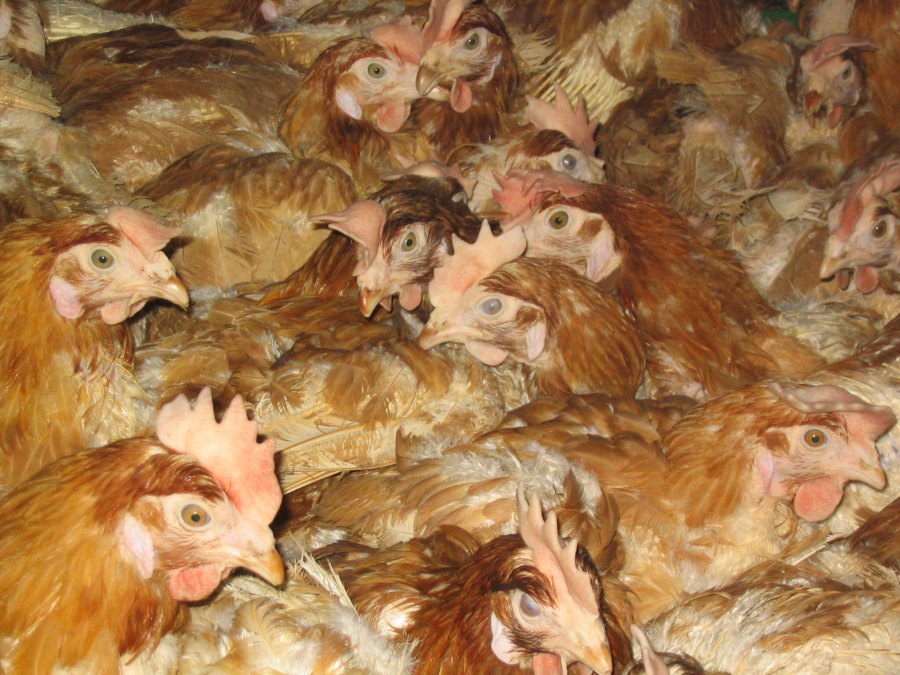
 Photo: Maqi · CC BY-SA 3.0 · source ↗

Deep litter system
The deep litter system is a poultry housing technique in which birds are reared on a thick absorbent bedding of crop residues built up to about 15 cm depth over the cycle. The bedding absorbs droppings, lets microbial fermentation break them down in place, and is removed only at the end of the batch. It is the standard floor system for broilers and country chicken in India and is taught in ICAR-CARI and TANUVAS poultry extension modules.
Principle
A continually maintained dry, friable litter mat insulates the floor, absorbs moisture from droppings and waterers, and supports a microbial community whose activity raises litter temperature, drives breakdown of uric acid, and synthesises B-group vitamins — including vitamin B12 and B2 — that birds pick up by ingestion of small quantities of litter. Spent litter at the end of the batch is a nitrogen-rich farmyard manure prized in horticultural cropping.
Implementation
The shed floor is laid with rice husk, paddy chaff, sawdust, groundnut hulls or chopped paddy straw at approximately 10 kg of litter per square metre. Starting depth at chick placement is around 5 cm; the bed is topped up and raked through the cycle to reach a final depth of about 15 cm. Litter is raked once a week in cool weather and twice a week in summer to break crust and re-expose moist material. Caking under waterers is removed and replaced with fresh material. The system is paired with inter-batch sanitation (Biosecurity Cleaning Between Batches) and a 10-14 day downtime before fresh litter is laid for the next batch.
Adoption context
Deep litter is universal in commercial broiler grow-out (Broiler Chicken, Contract Broiler Farming) and is also widely used in semi-intensive country-chicken units (Country Chicken Nattu Kodi), Sonali (Sonali Breed) and Kadaknath (Kadaknath) farms. Brooding (Brooding Chicks) is conducted directly on pre-warmed deep litter.
Limitations
Wet litter is the central failure mode: leaking waterers, high stocking density or poor ventilation (Open Poultry Shed) produce a caked, ammoniated bed that raises chick mortality (Poultry Mortality Management), eye and respiratory irritation and footpad dermatitis. Litter management therefore depends on disciplined waterer placement, ventilation and weekly raking. Layer farms with battery cages avoid deep litter entirely.
Related entries
See also: Shed Height Ventilation.
References
- Deep Litter System in Poultry Production. KVK Senapati, ICAR-NICRA.