 Photo: Wanas Rosa · Pexels License · source ↗
On-farm self-mixed poultry feed
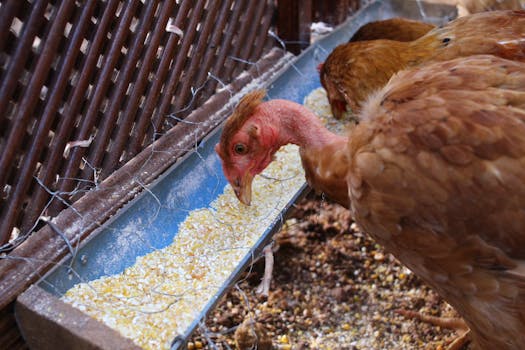
On-farm self-mixed poultry feed is the practice of preparing balanced broiler or layer rations at the farm rather than purchasing branded compound feed from a mill. Independent country-chicken farms, layer units that source ingredients in bulk, and Sonali and Kadaknath rearers operate small grinding-and-mixing units that turn out 2-3 tonnes a day of phase-specific feed.
Principle
Feed accounts for roughly two-thirds of the total cost of poultry production. By directly purchasing maize, soybean meal, oilcakes and additives — and skipping the feed-mill margin, branded packaging and transport overhead — farmers can lower per-kg feed cost meaningfully, especially when ingredient prices are favourable. The trade-off is that the operator must master ration formulation, ingredient quality control and consistent mixing.
Composition
A typical broiler self-mix ration combines maize (50-55%) as the energy base, soybean meal (20-25%) as the principal protein source, de-oiled rice bran (DORB) or wheat bran for fibre, oilseed cakes (groundnut or cottonseed) for additional protein, di-calcium phosphate and a mineral mixture for skeletal development, common salt, and a vitamin-trace-element premix. Phase targets follow standard guidelines (Starter Grower Finisher Feed): 22-24% crude protein in starter feed for the first three weeks, 20-22% in grower (weeks 3-6), and 18-20% in finisher feed. Layer feeds raise the calcium fraction sharply at point-of-lay to support shell formation. ICAR-CARI and ICAR-NIANP publish ingredient composition and Ca/P balance tables used in formulation, and BIS IS:1374 lays down compositional standards for compounded poultry feed grades.
Implementation
A village self-mixing unit typically uses a hammer mill (about 5 HP), a vertical or horizontal mixer of 200-500 kg batch capacity and a covered ingredient store. Maize and soybean meal are tested for moisture and visual mould on receipt. Daily mixing tickets specify ingredient quantities per batch, premix is added last to ensure uniform distribution, and the mixed feed is stored in jute or HDPE bags away from rodents.
Adoption context
Self-mixing is widespread in standalone broiler (Broiler Chicken) and layer (Layer Chicken Bv 380, Commercial Layer Farming) farms outside the integrator system, and in country-chicken (Country Chicken Nattu Kodi), Kadaknath (Kadaknath) and Sonali (Sonali Breed) units where the slow grow-out gives ingredient-cost savings high leverage on margin.
Limitations
Inconsistent ingredient quality, mycotoxin contamination of maize or DORB, micronutrient under-dosing and mixing-error variability all show up downstream as raised feed conversion ratio (Feed Conversion Ratio) and elevated mortality (Poultry Mortality Management). Excess dietary calcium without matching phosphorus, combined with hard water, predisposes birds to visceral gout (Water Hardness Poultry). Contract broiler agreements rarely permit self-mixing because the integrator's payment formula assumes a known feed composition.
Related entries
See also: Starter Grower Finisher Feed.
References
- Broiler Feed Formulation Guide. Poultry Affairs.