 Public domain · source ↗

Rice blast (leaf and neck blast / medavirupu, manipandu)
Rice blast, locally called medavirupu (leaf blast) and manipandu (neck blast), is caused by the ascomycete Magnaporthe oryzae (anamorph Pyricularia oryzae). It is the most widely studied disease of rice and a recurring driver of fungicide use across Indian paddy.
Identification and symptoms
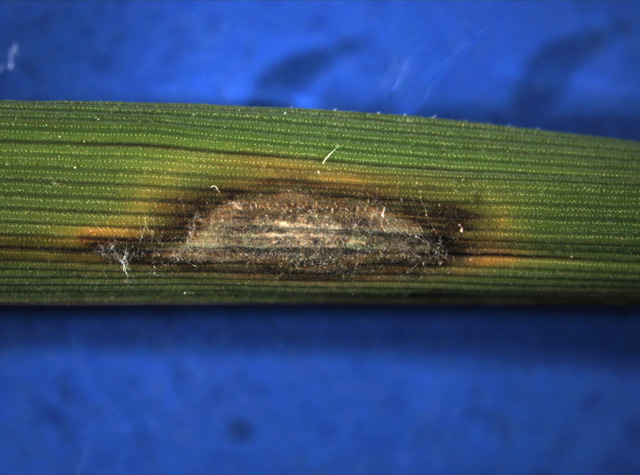
Leaf blast lesions are diamond- to spindle-shaped, grey-centred with brown margins. Node blast rots stem internodes, often causing breakage. Neck blast - the most destructive phase - colonises the base of the panicle (the 'neck') at heading, turning the entire panicle pale and chaffy, a symptom called manipandu. Collar blast at the leaf-collar and grain blast on individual spikelets also occur.
Host crops and life cycle
The fungus produces airborne conidia carried by wind and dew. Inoculum survives on crop stubble, infected seed and grassy hosts. Cool nights, prolonged dew, dense planting and high or late nitrogen rates favour epidemics. Rabi/yasangi paddy in Telangana and Andhra Pradesh is particularly vulnerable.
Damage and economic impact
Susceptible varieties under conducive weather can suffer near-total panicle loss from neck blast. Leaf blast also reduces functional leaf area and grain filling. Across Asia rice blast is consistently the single most economically important fungal disease of rice.
Management
- Resistant varieties: Drr Dhan 75, Rnr 15048 and Knm 118 Kunaram Sannalu are blast-resistant fine-grain lines deployed in Telangana and AP as replacements for susceptible older cultivars such as Bpt 5204.
- Cultural: balanced and split nitrogen, wider spacing, and avoidance of highly susceptible varieties in known endemic blocks.
- Chemical: ICAR-IIRR-coordinated trials confirm seed treatment with tricyclazole 75 WP at 3 g/kg followed by two foliar sprays at 0.6 g/L for combined leaf and neck blast control. Trifloxystrobin + tebuconazole, prochloraz + tricyclazole and isoprothiolane give over 70% disease reduction in published evaluations. Boot-stage spraying (Paddy Panicle Stage Management) is essential for neck blast control.
Related entries
See also: Paddy Blast Disease, Bacterial Leaf Blight Paddy, Brown Spot Paddy, Sheath Blight Paddy, False Smut Paddy, Drr Dhan 75, Rnr 15048.
References
- Management of rice blast with modern combination fungicides. Vegetos (Springer).
- Field evaluation of fungicides for rice blast. J. Res. ANGRAU (ICAR).