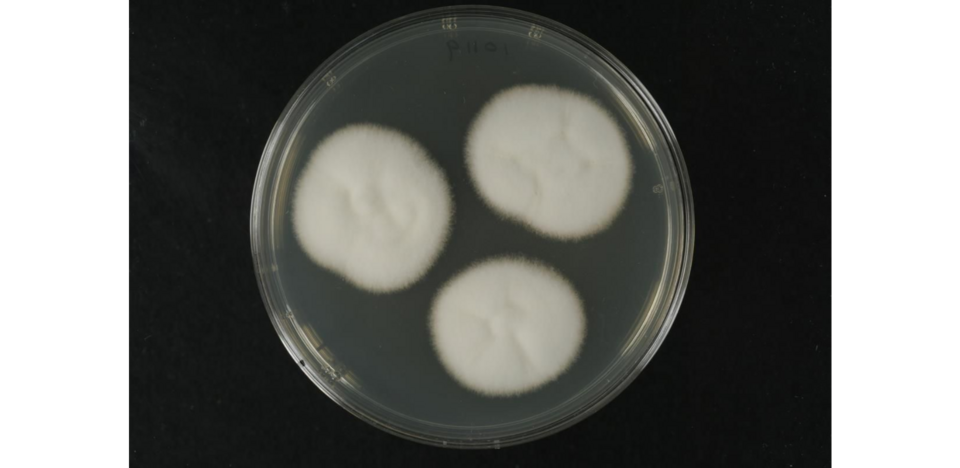
 Photo: W Thomas, Landcare Research · CC BY 4.0 · source ↗
.png)
Verticillium lecanii (Lecanicillium)
Verticillium lecanii, reclassified taxonomically as Lecanicillium lecanii, is an entomopathogenic fungus first isolated in India from aphid cadavers in tea plantations. It is now registered as a biopesticide for soft-bodied sucking pests including aphids, whiteflies, thrips, mealybugs and soft scales across a wide range of crops.
Composition
- Active organism: Lecanicillium lecanii (formerly Verticillium lecanii; Hyphomycete fungus)
- Indian origin: first isolated from aphid in Indian tea plantations
- Reference strain bank: ICAR-NBAIR, Bengaluru
- Standard Indian formulation: 1.15% wettable powder at minimum 1 x 10^8 CFU per gram
- Other formats: oil dispersion, liquid concentrate
Mode of action
Conidia adhere to the cuticle of the target insect, germinate in the presence of cuticular waxes and humid microclimate, and penetrate the integument through enzymatic action by chitinases and proteases. Inside the host, hyphal bodies multiply and produce dipicolinic acid and other secondary metabolites that kill the host within four to ten days, depending on temperature and humidity. Cadavers turn into characteristic white mycelial masses from which new conidia disperse.
Target use and dose
The fungus is registered for use on tomato, brinjal, chilli, capsicum, cabbage, banana, cotton, tea, coffee and citrus, targeting:
- Aphids and whiteflies on cotton, vegetables and pulses
- Thrips on chilli, capsicum and onion
- Mealybugs on cotton, brinjal, papaya, mango and pomegranate
- Soft scales on tea, coffee, citrus and ornamentals
Foliar spray: 2-5 g WP per litre of water, applied in the evening to maximise spore viability. Best efficacy occurs at relative humidity above 70%; spray coverage on the undersides of leaves is essential.
Safety and regulatory status
Registered under the Insecticides Act through CIB&RC and the FCO biopesticide schedule. Non-pathogenic to humans, mammals and most non-target arthropods. No fixed pre-harvest interval at label rates. Should not be tank-mixed with broad-spectrum chemical fungicides that kill spores.
Related entries
See also: Beauveria Bassiana, Metarhizium Anisopliae, Trichoderma Viride, Pseudomonas Fluorescens, Neem Oil.
References
- Lecanicillium lecanii. ScienceDirect topic overview.
- Lecanicillium spp. for Management of Aphids. IntechOpen chapter.