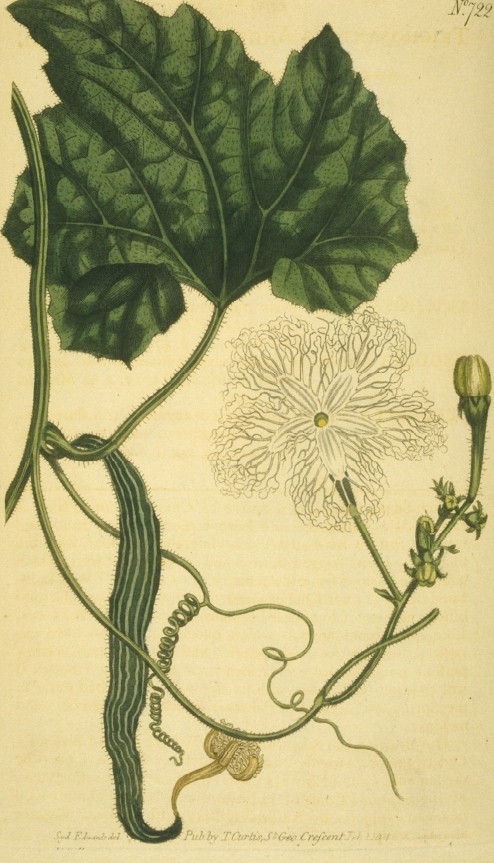
 Photo: S. Edwards, Sansum · Public domain · source ↗

Snake gourd (Trichosanthes cucumerina)
Snake gourd (Trichosanthes cucumerina var. anguina) is a monoecious tropical climbing cucurbit native to South and Southeast Asia, grown commercially for its strikingly long, slender, edible fruits. It is widely cultivated on pandals across south India, particularly in Tamil Nadu, Andhra Pradesh and Kerala, and is described in TNAU and ICAR extension materials.
Key characteristics
- Family: Cucurbitaceae
- Cultivated form: T. cucumerina var. anguina
- Harvest window: 40-50 days from planting
- Fruit length: 16-18 inches in long-fruited cultivars; shorter types are picked at 6-8 inches
- Pollination: insect-pollinated, primarily by Pyralidae moths
Cultivation
Snake gourd is direct-sown and trained on pandals or sturdy trellises to allow the fruits to hang straight and grow to their characteristic elongated shape; ground-grown fruits curl and lose market value. Plants set fruit through insect pollination, with each fruit yielding 50-70 seeds. Long-fruited cultivars are marketed at 16-18 inch length, while shorter selections are picked at 6-8 inches for tenderness.
Pest and disease profile
The crop shares the standard cucurbit pest complex with Ridge Gourd, Bottle Gourd and Bitter Gourd - fruit fly, red pumpkin beetle, downy and powdery mildew, and mosaic viruses. Pheromone-based fruit fly management and cucurbit-specific IPM modules are applicable.
Adoption and use
Snake gourd is primarily a south Indian vegetable, sold fresh, although it is also documented as an underutilised crop with nutraceutical research interest.
Related entries
See also: Bottle Gourd, Ridge Gourd, Bitter Gourd, Ivy Gourd Dondakaya, Pumpkin Crop, Watermelon Crop, English Cucumber Polyhouse, Teasel Gourd Aakakara.
References
- Trichosanthes cucumerina (snake gourd). Plantwise Plus Knowledge Bank, CABI.
- Snake Gourd: An Underutilized Crop with Great Potentials. ResearchGate.