 Photo: Huey Freeman · Pexels License · source ↗
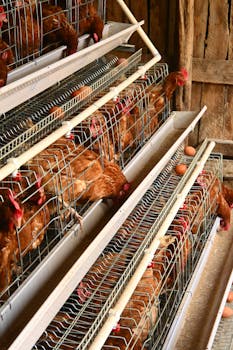
Three-tier battery cage system
The three-tier battery cage is the dominant commercial layer housing in India. It consists of wire-mesh cages stacked three tiers high in rows, each cage holding about three birds, with feed troughs, drinker lines and an egg-collection channel running the length of the row. Roughly 90 birds occupy each three-tier stack along a 1.95 m cage row.
Principle
The system maximises bird density per unit of shed area and eliminates the litter management associated with deep-litter housing (Deep Litter System). Each cage has a sloped wire floor of about 7-8 degrees so that eggs roll forward into a collection trough or onto a belt conveyor immediately after being laid, reducing the chance of cracks and contamination. Droppings fall through the wire floor of each tier into a collection area, removed mechanically by belt or scraped out manually. The bird never touches its own droppings, which sharply reduces parasitic and bacterial enteric load relative to floor housing.
Implementation
A standard three-tier stack is built on a galvanised-steel or angle-iron frame, raised at least about 6 ft above the floor of the shed to leave manure-collection access below the lowest tier. Cages are arranged in long parallel rows down the shed, separated by service aisles. Feed is delivered by an overhead chain or hand-pushed trolley into trough lines; nipple drinkers supply water. Lighting is controlled to manage photoperiod through the long single-batch layer cycle (Commercial Layer Farming). Bird strains such as BV-380 (Layer Chicken Bv 380) are bred specifically for cage rearing.
Adoption context
The system is the standard for layer farms above a few thousand birds across the Indian commercial belt — Namakkal in Tamil Nadu, Coastal Andhra, Telangana, Maharashtra, Haryana and Punjab — and is used both in open-sided sheds (Open Poultry Shed) and in environmentally controlled houses (Ec Poultry Shed). Inter-batch sanitation (Biosecurity Cleaning Between Batches) is more straightforward in cage systems than in deep-litter floors because there is no built-up litter to remove; the cages themselves and the manure pits are washed and disinfected. End-of-cycle spent-hen marketing (Spent Hen Marketing) is conducted as a single sweep.
Limitations
Battery cages are at the centre of the global cage-free egg debate. Birds have very limited movement and cannot perform natural behaviours such as dust-bathing, perching or nesting. Long confinement also predisposes hens to osteoporotic fractures, particularly during catch-out at end of cycle. A small but growing cage-free or enriched-cage segment in India is driven by quick-service-restaurant procurement commitments, but battery cages remain the default housing for the vast majority of Indian commercial layer production.
Related entries
See also: Commercial Layer Farming.
References
- Poultry Layer Farming Model Bankable Project. NABARD.