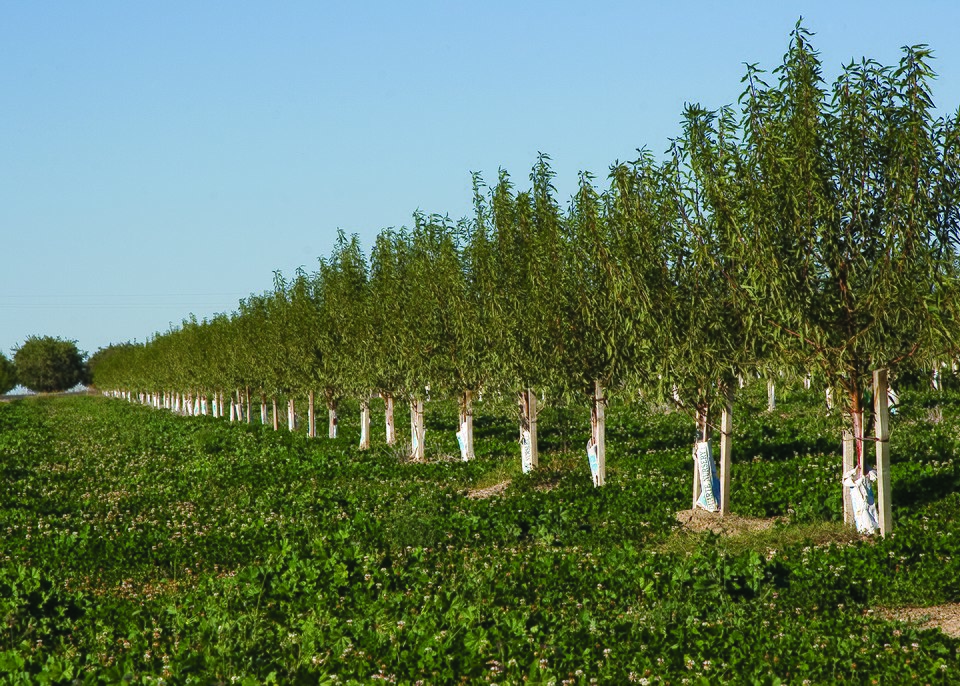
 Photo: Photo courtesy of USDA Natural Resources Conservation Service. · Public domain · source ↗
(NRCS_Photo_Gallery).jpg)
Legume intercropping in orchards
Legume intercropping in orchards is the practice of sowing nitrogen-fixing pulses and oilseeds in the inter-row of widely-spaced fruit trees during the 2-5 year gestation phase before the main crop reaches commercial bearing. The system delivers interim cash flow, fixes biological nitrogen and protects the soil surface while the perennial establishes.
Principle
Young orchards on 4x4 m to 10x10 m spacing leave large bands of inter-row space that receive nearly full sunlight. Annual or short-duration legumes — groundnut, redgram (pigeonpea), greengram, blackgram, horsegram, chickpea — capture this light and contribute biologically-fixed nitrogen to the soil through root nodules colonised by Rhizobium. ICAR research records 50-200 kg N/ha per season depending on species, a substantial fraction of which becomes available to the perennial as legume residues decompose.
Implementation
Recommended legumes include groundnut, redgram (pigeonpea), greengram, blackgram and horsegram. Pigeonpea plus groundnut is a recurrent recommendation in southern Indian orchards. Sowing follows the main rainy-season window for the legume, with a 1-1.5 m buffer maintained around each tree. Documented yield gains of 30-35 percent in main-crop-equivalent terms are reported with appropriate legume choice and spacing. Incorporation of legume haulm and root residue after harvest returns organic carbon and nitrogen to the orchard soil.
Adoption context
The practice is widely used in young mango, citrus, guava, sapota, custard apple and pomegranate orchards across Karnataka, Tamil Nadu, Andhra Pradesh, Telangana, Maharashtra and Gujarat. It is the default extension recommendation for the gestation phase of any new orchard and is a structural component of the broader Integrated Farming System framework.
Limitations
Legume choice must be matched to soil type, rainfall and the perennial's root profile. Pest pressure on the legume can spill over to the main crop in some combinations. As the main crop canopy closes from year 4-5 onwards, intercrop yields decline and the practice is phased out. Mechanised harvest of the legume must avoid damaging young tree roots.
Related entries
See also Integrated Farming System, Areca Coconut Intercrop System, Intercrop Oil Palm Young and Turmeric Ginger Papaya Maize Rotation.
References
- Legume intercropping review. Frontiers in Sustainable Food Systems, 2025.