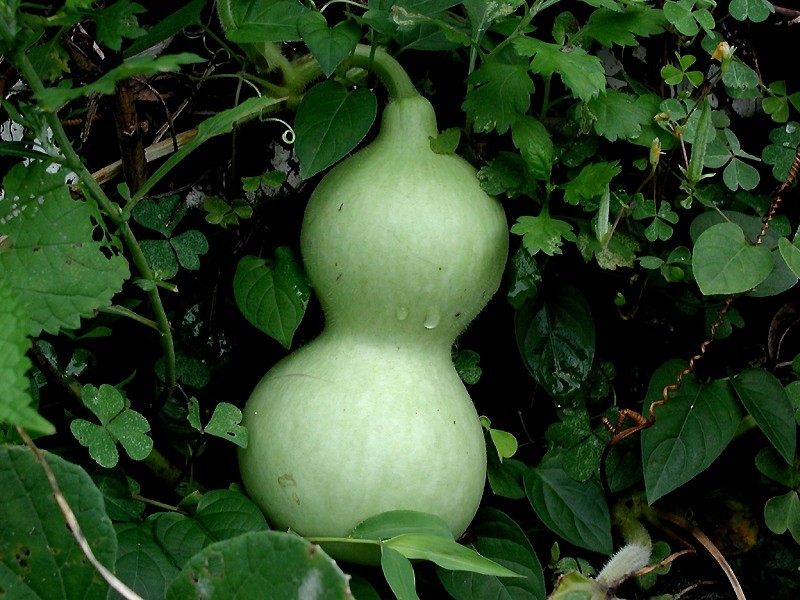
 Photo: 撮影者はカールおじさんです。 · CC BY-SA 3.0 · source ↗

Bottle gourd (Lagenaria siceraria)
Bottle gourd (Lagenaria siceraria) is a vine cucurbit grown across India for its tender immature fruits, which are consumed as a vegetable and used in traditional preparations. The crop is widely cultivated on pandals and trellises in home gardens and commercial open-field plots.
Key characteristics
- Family: Cucurbitaceae
- Optimum temperature: 30-35 degC day / 18-22 degC night
- Harvest window: 55-75 days after sowing
- Soil preference: sandy-loam, well-drained, rich in organic matter
Cultivation
Standard package of practices specifies sandy-loam soils with high organic matter, basal farmyard manure at 10-15 t/ha, and frequent irrigation at 4-5 day intervals in the summer crop. Vines are trained on pandals or trellises to improve fruit shape, reduce ground rot and ease harvesting. The crop is sensitive to waterlogging in rainfed conditions and benefits from raised beds in heavy soils.
Pest and disease profile
Bottle gourd shares the standard cucurbit pest complex with Bitter Gourd, Ridge Gourd and Snake Gourd - fruit fly (Bactrocera cucurbitae), red pumpkin beetle, downy and powdery mildew, and root-knot nematode. Vector-borne mosaic viruses transmitted by aphids and whiteflies are increasing concerns in extended cropping cycles.
Adoption and use
Both open-pollinated and F1 hybrid bottle gourd varieties are widely commercialised. Fruits are harvested while the rind is still tender and green; over-mature fruits become woody and unmarketable, making harvest timing critical to economic returns.
Related entries
See also: Ridge Gourd, Bitter Gourd, Snake Gourd, Ivy Gourd Dondakaya, Pumpkin Crop, Watermelon Crop, Teasel Gourd Aakakara, English Cucumber Polyhouse.
References
- Bottle Gourd (Lagenaria siceraria). KIRAN/ICAR-RC NEH.
- Bottle Gourd Production Guideline. National Department of Agriculture.