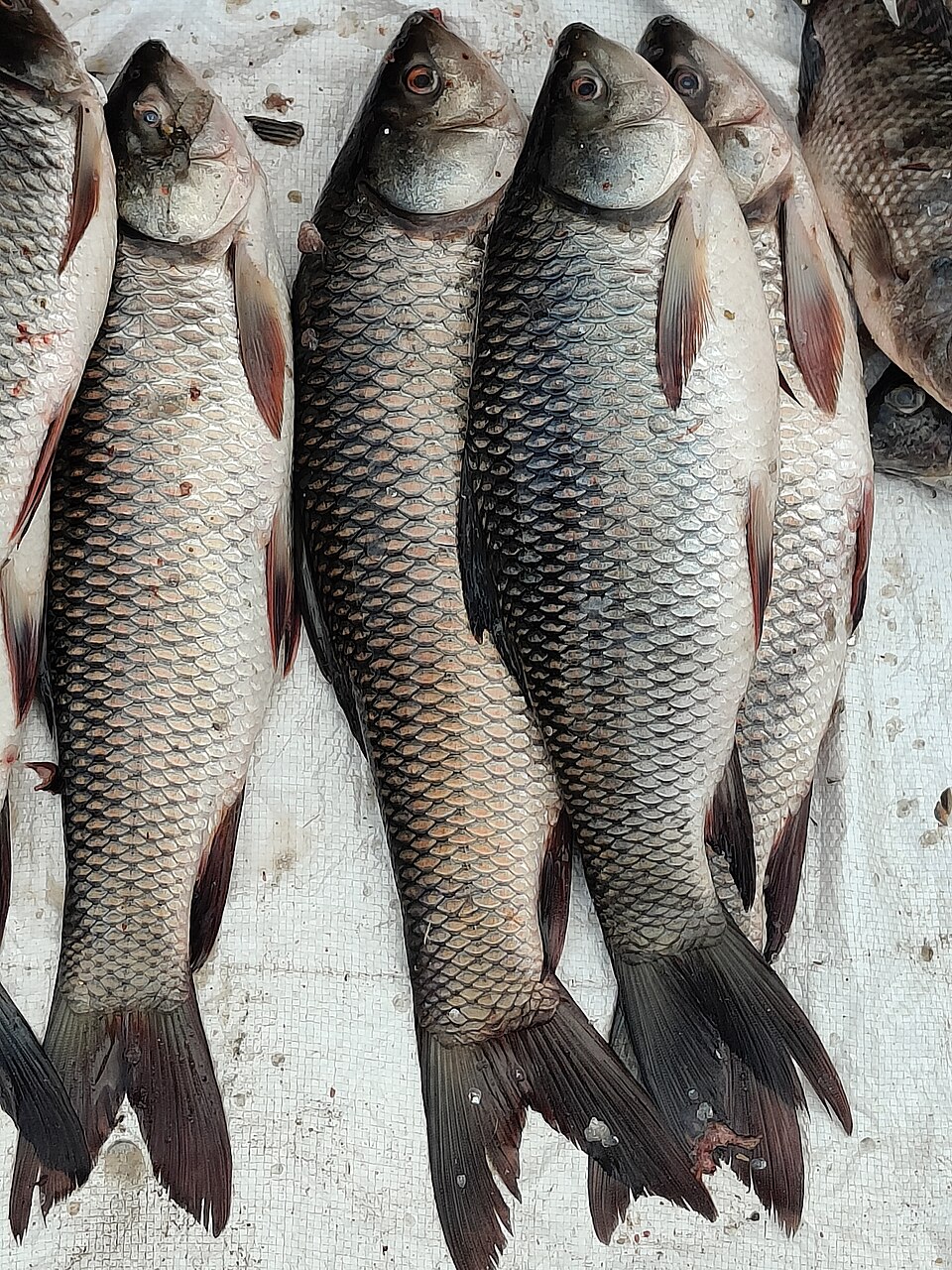
 Photo: Ranjithkumar Murugesan · CC0 · source ↗

Indian major carp polyculture
Indian major carp polyculture, also known as composite fish culture, is the practice of stocking several complementary carp species in the same freshwater pond so that all feeding niches in the water column are utilised. It is one of the most widely practiced freshwater aquaculture systems in India and the basis for inland production of rohu, catla and mrigal.
Principle
Each species occupies a distinct feeding niche: catla feeds on surface zooplankton, rohu in the column, mrigal at the bottom, and grass carp (Grass Carp) on aquatic and terrestrial vegetation. Silver carp and common carp are sometimes added for plankton and detritus respectively. By combining feeders that do not compete for the same food, total fish yield per hectare exceeds what any single species would produce.
Implementation
ICAR-CIFA and ICAR-CIFRI extension recommend a six-species ratio of about 4:2:3:1 across surface, column, bottom and macrophyte feeders, with silver and common carp completing the mix. A simpler three-species pond in eastern and southern India typically uses catla 30-35%, rohu 60% and mrigal 10%. Standard stocking density is about 5,000 fingerlings per hectare in grow-out ponds, sourced from accredited hatcheries (see Fingerling Seed Quality). Ponds follow standard earthen-pond engineering (Fish Pond Construction) with overhead netting against fish-eating birds (Pond Biosecurity Bird Snake Netting). Grass carp are fed directly with fresh grass, paddy straw and aquatic weeds, reducing pellet feed demand.
Adoption context
Yields of 3-5 t/ha/year of table-size 1-1.5 kg fish are commonly reported under recommended management. Carp polyculture is supported under the Pradhan Mantri Matsya Sampada Yojana (Pmmsy) through subsidies for pond construction, seed and feed.
Limitations
Yields decline sharply with poor seed quality, inadequate liming or fertilisation, weed-choked ponds, and predation by birds and snakes. Stunted growth and disease outbreaks are common where stocking ratios are mismatched to the pond's plankton load.
Related entries
See also: Grass Carp, Fish Pond Construction, Fingerling Seed Quality, Pond Biosecurity Bird Snake Netting, Bamboo Fish Traps.
References
- Carp polyculture in India. Global Seafood Alliance.
- Composite Fish Culture: Definition and Objectives. Fish Farming Techniques.
- Grow-out and polyculture - Carps. Brainkart.