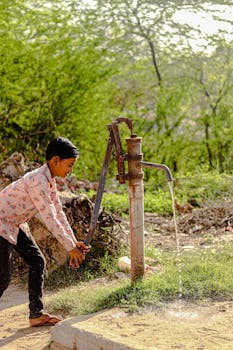
 Photo: Swastik Arora · Pexels License · source ↗
Borewell (vertical)
A vertical borewell is a drilled well that taps groundwater from weathered and fractured zones of underlying rock. It is the primary irrigation source for orchards, paddy and vegetables across India in regions without canal command. The Central Ground Water Board (CGWB) under the Ministry of Jal Shakti is the principal regulator and exploration agency.
Principle
Drilling penetrates the soil cover and weathered zone to reach productive fractures or porous aquifer layers below. In sedimentary basins the saturated zone may be a continuous porous aquifer; in hard-rock terrain water is held in thin weathered overburden and in structural fractures intersected by the bore. A casing seals the upper soil profile, and the well is screened or left open in the producing zone.
Implementation
CGWB operates 88 drilling rigs of Direct Rotary, Down-The-Hole (DTH) and Percussion-Combination types for exploratory drilling. In commercial drilling, DTH rigs predominate in hard rock; mud-rotary rigs are used in alluvium. In Telangana, which is roughly 80% hard rock comprising granites, gneisses and Deccan basalts, tubewells typically extend to 100 metres or beyond. Casing diameter, depth and pump capacity are matched to the expected yield and aquifer drawdown.
Adoption context
Yields in hard-rock zones are typically 2-5 litres per second. Bore success depends strongly on intersecting productive fractures, which is the role of Borewell Siting Methods. In coastal saline tracts where vertical drilling risks intersecting brackish water, Horizontal Borewell systems are used instead. Many orchards run multiple bores per holding for redundancy.
Limitations
Hard-rock bores commonly fail at 300-400 feet in drought-stressed zones, yielding no water despite drilling cost. Flow declines over the life of the bore as the local fracture network depletes; long-running bores show progressive drop in delivery over decades unless recharge is augmented through Rainwater Recharge Pits. Energy cost of pumping rises with deeper water tables.
Related entries
See also: Borewell Siting Methods, Horizontal Borewell, Rainwater Recharge Pits.
References
- CGWB Groundwater profile - Telangana. Central Ground Water Board.
- CGWB Telangana district profiles. Central Ground Water Board.
- CGWB organisation and drilling fleet. Central Ground Water Board.