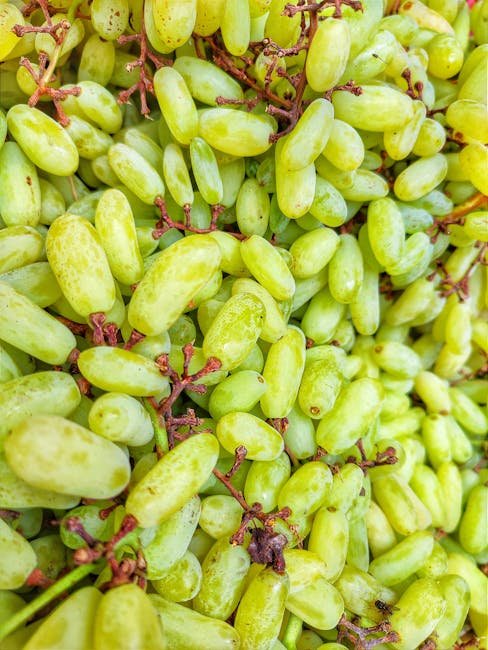
 Photo: Javeriya · Pexels License · source ↗
GrapeNet APEDA traceability system
GrapeNet is the internet-based traceability system maintained by the Agricultural and Processed Food Products Export Development Authority (APEDA) of the Ministry of Commerce and Industry. Launched in 2006, it was India's first major end-to-end electronic farm-to-port traceability platform for a horticultural commodity and is widely cited as a model implementation. It enables EU and UK importers to verify the entire production history of every consignment of fresh Indian grapes.
Principle
The EU Regulation 178/2002 requires food business operators to provide one-step-back, one-step-forward traceability for all imported food. For grapes from India, this is operationalised through GrapeNet: the grower farm plot, spray history, residue test, packhouse, exporter and consignment are all linked through a unique identifier printed on the pallet and on each carton, allowing instant lookup of provenance.
Implementation
The system has four registration tiers:
- Farmer registration: each export plot registers with APEDA through the State Government Horticulture/Agriculture department; the farmer receives a GrapeNet ID, GPS-mapped plot, variety, area, planting year.
- Spray-diary entry: a facilitator (often a State Horticulture officer or APEDA-registered exporter) records each spray date, active ingredient, dose and pre-harvest interval on GrapeNet.
- Residue test booking: pre-harvest sample is drawn by the lab; results uploaded to GrapeNet. Compliance with destination MRL (Grapes Export Residue Mrl Europe) is verified before shipment is cleared.
- Packhouse and consignment registration: APEDA-recognised packhouse logs the consignment; GrapeNet generates a unique consignment-level traceability code which is printed on every export carton and pallet.
The data are accessible to EU border control, which can scan a carton QR or look up a code to confirm full traceability. Indian customs uses GrapeNet clearance as a pre-condition for issuing the Phytosanitary Certificate.
Where it applies
GrapeNet is mandatory for fresh-grape exports to the European Union, the United Kingdom, the Netherlands, Germany and increasingly the GCC; it covers the bulk of exports from Nashik, Sangli, Solapur, Pune, Satara, Vijayapura and other Maharashtra/Karnataka clusters. The platform has been replicated as PeanutNet, MeatNet and BasmatiNet for other commodities.
Limitations
GrapeNet's effectiveness depends on the integrity of the spray-diary entries; under-reporting of sprays is a recurring audit concern. Small growers without smartphones rely on facilitators, creating a single point of failure. The system also does not cover residues from drift, illegal stocks, or non-registered products - those have to be controlled through the residue-test stage.
Related pages
See also: Grapes Export Residue Mrl Europe, Grapes Thompson Seedless, Grapes Pruning Foundation Fruit.
Sources
- GrapeNet. APEDA.
- Export of Fresh Grapes from India. APEDA.