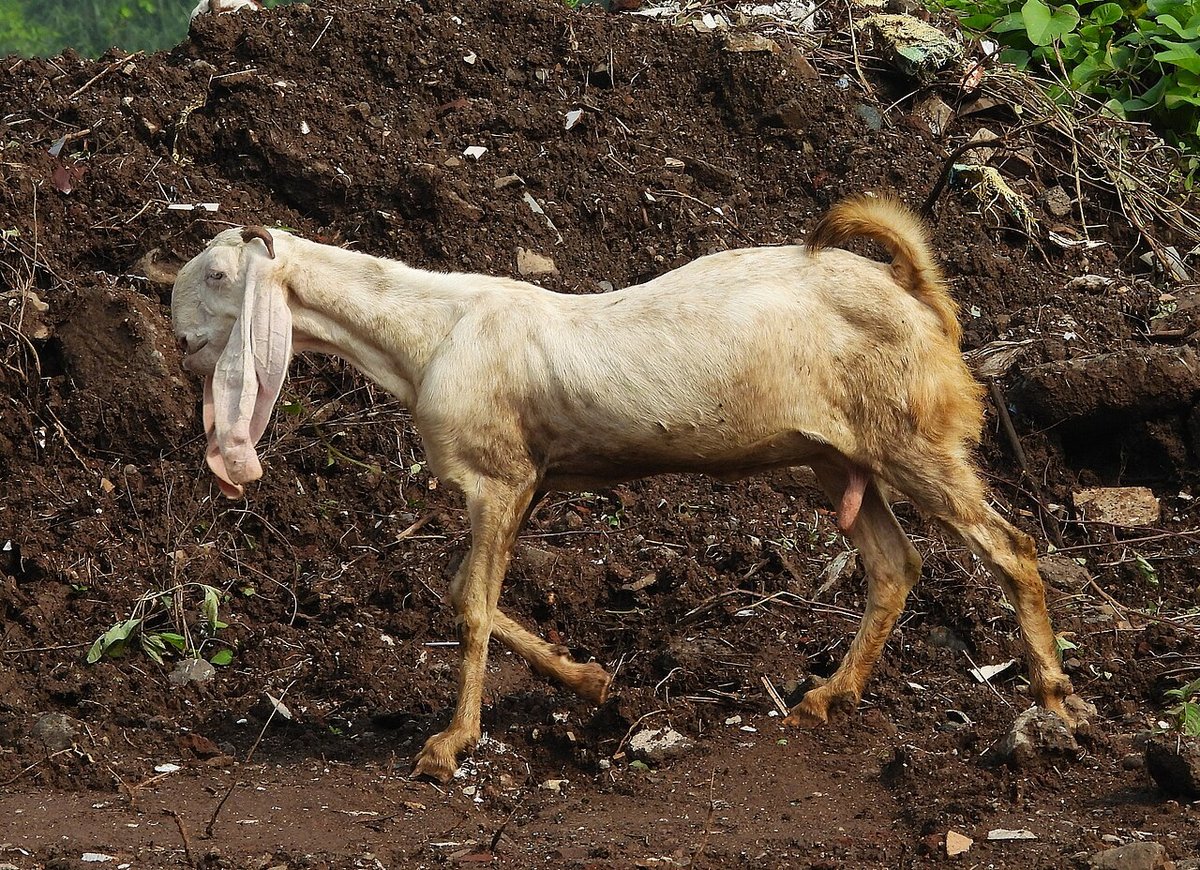
 Photo: Dr. Raju Kasambe · CC BY 4.0 · source ↗
.jpg)
Jamunapari goat
Jamunapari is India's tallest and most distinctive dual-purpose (milk-and-meat) goat breed, registered with the ICAR National Bureau of Animal Genetic Resources (NBAGR). It is the foundation breed used to grade up the small-ruminant population across many Telugu farms looking for higher milk yield and frame size than the local Osmanabadi or non-descript stock.
Origin and distribution
The home tract lies in the Chakarnagar block of Etawah and adjoining Bhind and Morena districts on the Chambal-Yamuna ravine belt of Uttar Pradesh and Madhya Pradesh. From there, ICAR-CIRG (Makhdoom) and state goat farms have distributed bucks and breeding does into Andhra Pradesh, Telangana, Karnataka and Maharashtra, where Jamunapari is used in cross-breeding programmes with Osmanabadi (Osmanabadi Goat) and local goats.
Morphology
Jamunapari is a large, tall, leggy goat with a typical Roman-nose profile and very long, pendulous ears that hang well below the chin. The coat is predominantly white, often with tan or black patches on the head, neck and back. Adults are heavily framed: bucks weigh 65-85 kg, does 45-60 kg. The udder is large and well-developed, befitting the breed's dairy origins.
Yield and productivity
Jamunapari is reared for both milk and meat. Daily milk yield is 1.5-2.5 kg over a 180-200 day lactation, with elite animals exceeding 3 kg/day. Kidding is usually single, occasionally twin; age at first kidding is 18-20 months. Mature carcass weight and bone size command a premium in Bakrid ram-and-buck markets (Ram Fattening Bakrid), making fattened Jamunapari and Jamunapari-cross bucks the highest-priced segment in many Telugu mandis.
Management
Jamunapari needs better feeding than local goats to express its yield potential. Concentrate supplementation, good-quality green fodder (Subabul, Sesbania, hedge lucerne), and clean water are essential. The breed is highly susceptible to PPR (peste des petits ruminants) and CCPP; vaccination (Small Ruminant Vaccination Schedule) is non-negotiable. Elevated slatted floor sheds (Elevated Goat Sheep Shed) suit the breed's preference for dry standing surfaces. Compared with Black Bengal (Black Bengal Goat) the breed has lower prolificacy but much larger frame and milk yield.
Related pages
See also: Black Bengal goat, Osmanabadi goat, Ram fattening for Bakrid, Elevated goat-sheep shed.
Sources
- Jamunapari - NBAGR breed descriptor. ICAR-National Bureau of Animal Genetic Resources.
- Jamunapari goat. ICAR-Central Institute for Research on Goats, Makhdoom.