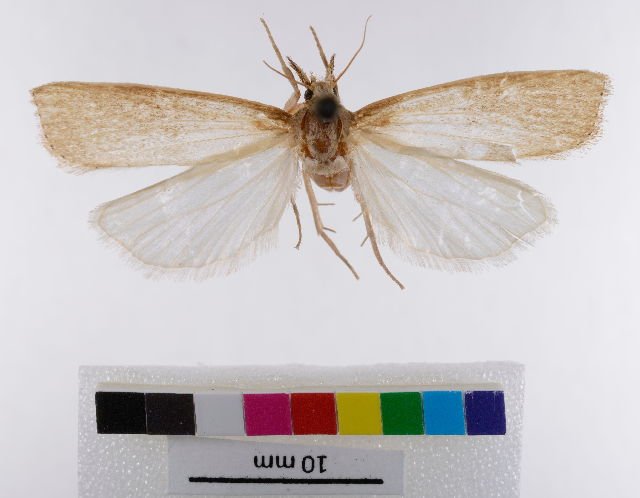
 Photo: GBIF contributor · see GBIF record · source ↗
Sugarcane early shoot borer (Chilo infuscatellus)
The early shoot borer Chilo infuscatellus Snellen (Lepidoptera: Crambidae) is the most damaging pest of peninsular Indian sugarcane in the first 90 days after planting. Larvae bore into young shoots before the cane has formed nodes, killing the central whorl and producing the characteristic "dead heart" symptom. In Maharashtra, Karnataka, Andhra Pradesh, Telangana and Tamil Nadu the pest causes 15-40% shoot loss in unmanaged plantings, equivalent to 10-25% cane yield reduction.
Identification
- Adult: small straw-coloured moth, 12-15 mm long; forewings pale yellowish-brown with dark dots; nocturnal, weak flier
- Egg: cream-coloured, flat, scale-like, laid in overlapping clusters of 10-30 on the underside of basal leaves
- Larva: dirty white with five longitudinal violet stripes, head capsule yellow-brown; full-grown 25-30 mm; the violet-striped body is the field-diagnostic character that separates it from internode borer and stalk borer
- Pupa: brown, in a silken cocoon inside the dead shoot at soil level
- Damage symptom: central leaf whorl turns straw-coloured and wilts ("dead heart"); pulling the dead whorl shows a slimy cut at the base with a clean bore tunnel; foul smell from dead-heart tissue
Hosts and lifecycle
C. infuscatellus infests sugarcane, sorghum, maize and several wild grasses. On peninsular cane the pest is active from February to June (the early-shoot stage of suru and Adsali plantings). Eggs hatch in 4-6 days; larval period 25-30 days with 5 instars; pupation 7-10 days; total lifecycle 35-45 days; 4-5 overlapping generations per crop. The pest does not bore canes that have already formed internodes — once the cane elongates past the 4-5 internode stage, C. infuscatellus damage stops and internode borer (Chilo sacchariphagus indicus) takes over.
Damage and economic impact
Each killed shoot eliminates one potential millable cane. At 30% dead-heart incidence, plant population drops below the threshold for ratoon recovery, and yield loss compounds across plant and ratoon crops. Maharashtra and Karnataka cane departments rate early shoot borer as the no.1 cane pest by area treated. Susceptible variety Co 86032 (see co-86032-nayana-sugarcane) and CoC 671 are key dead-heart hosts.
Management
ICAR-SBI Coimbatore and NIPHM AESA package:
- Cultural: deep summer ploughing to expose pupae; trash mulching of basal soil to deter egg-laying; earthing-up at 60-90 days to bury infested basal shoots; removal and destruction of dead-heart shoots by pulling and burning
- Resistant varieties: avoid continuous Co 86032; rotate with Co 94012, CoM 0265, Co 0238 (subtropical), Co 99004 which show lower dead-heart percentages
- Bud-chip nursery transplant: transplanting 35-45 day old bud-chip seedlings (see sugarcane-bud-chip-nursery) past the most vulnerable shoot stage cuts dead-heart by 50-70%
- Mechanical: pheromone traps at 12 per hectare from 30 DAP to monitor moth flights and time chemical sprays
- Biological:
- Egg parasitoid Trichogramma chilonis released at 50,000/ha at 7-10 day intervals for 6 releases starting 25 DAP
- Larval parasitoid Cotesia flavipes released at 250 mated females/ha at 60 DAP
- Granulosis virus (ChinGV) at 6 x 10^11 OB/ha spray
- Chemical: at 30-45 DAP if dead-heart >15%: chlorantraniliprole 18.5 SC at 0.3 ml/L soil drench around the base, or fipronil 0.3 G at 25 kg/ha basal application, or carbofuran 3 G at 33 kg/ha (where still permitted). Avoid foliar pyrethroids which kill the parasitoid complex
Related pages
See also: Sugarcane crop, Co 86032 sugarcane, Sugarcane top borer, Sugarcane mealy bug, Sugarcane bud-chip nursery, Sugarcane ratoon crop.
Sources
- AESA based IPM Sugarcane. National Institute of Plant Health Management, Hyderabad.
- Sugarcane crop protection. ICAR-Sugarcane Breeding Institute, Coimbatore.
- Chilo infuscatellus factsheet. CABI Compendium.