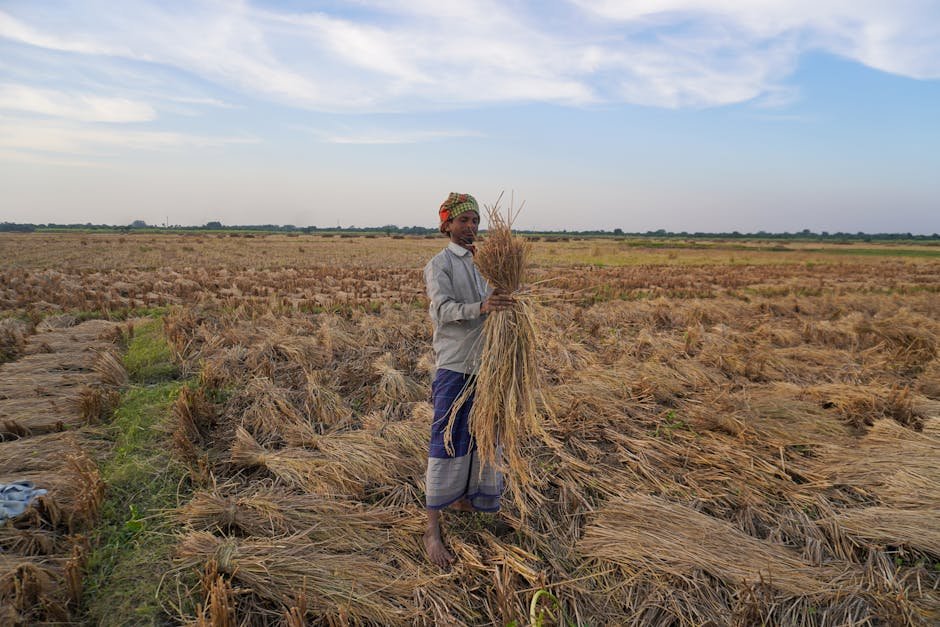
 Photo: Habib Billah · Pexels License · source ↗
Yield data and Crop Cutting Experiments (CCEs) for PMFBY
A Crop Cutting Experiment (CCE) is the standardised field-level sampling procedure used to estimate the average yield of a notified crop in a notified Insurance Unit. CCEs are the technical basis on which PMFBY claims under the yield-based component are calculated, and they predate PMFBY by decades — being also the primary input for India's official crop production statistics.
Principle and history
CCEs were institutionalised in the 1940s by the Indian Statistical Institute (P C Mahalanobis) for objective yield estimation. The General Crop Estimation Survey (GCES), run by NSSO and state agriculture/statistics departments, has used CCEs to produce district-, state- and national-level crop yield series for over seven decades. PMFBY adopted the same methodology, scaled up to the Insurance Unit (gram panchayat or village).
How a CCE is conducted
- Selection of villages and survey numbers: Random sampling within the Insurance Unit based on a notified cropping pattern
- Selection of plot and sub-plot: Random plot within the survey number; standard sub-plot size of 10 m × 5 m for most crops (5 m × 2 m for sugarcane, fruit-by-tree-count for orchards)
- Harvest of sub-plot: At physiological maturity, all produce within the sub-plot is harvested, threshed and weighed in-field
- Moisture correction: Yield converted to standard moisture (12% for paddy, 12% for wheat etc.)
- Recording: Field-team enters yield in kg/sub-plot on the CCE Mobile App; geo-tagged photographs of the sub-plot at four corners are mandatory under the 2020 reforms
Number of CCEs per Insurance Unit
The Operational Guidelines prescribe a minimum number of CCEs per crop per Insurance Unit:
- 4 CCEs per gram panchayat for major notified crops
- 8 CCEs per revenue circle/block where the IU is larger
- 24 CCEs per district as a fallback minimum
Lower counts trigger statistical confidence concerns and can be challenged by insurers.
Threshold Yield and claim calculation
PMFBY claims are based on the Threshold Yield (TY):
- TY = Average Yield × Indemnity Level
- Average Yield: simple average of yields of the past 7 years, excluding 2 calamity years
- Indemnity Level: 70%, 80% or 90% — chosen by the state at the time of notification
If the CCE-measured Actual Yield (AY) of the season is below TY:
- Claim per hectare = (TY − AY) / TY × Sum Insured per hectare
The claim is paid uniformly to every insured farmer in that Insurance Unit, regardless of their individual plot-level yield.
Technology in CCEs
The 2020 Revamped PMFBY required mandatory geo-tagging of CCE sub-plots, two-stage smart sampling using satellite imagery (NDVI/EVI-based prioritisation), and a CCE Mobile App for state agriculture staff. Remote sensing-aided yield estimation pilots run alongside CCEs in selected districts for cross-validation. Smart sampling is supposed to reduce CCE workload by 30-40% while improving precision.
Common disputes
CCE disputes are the single largest source of PMFBY claim litigation:
- Sub-plot selected from a roadside or low-yield strip (insurer-favourable)
- Sub-plot selected from a well-irrigated patch when most of the IU is rainfed (farmer-favourable)
- Late CCE due to harvest delays or staff absence
- Moisture correction errors
- Yield reported above realistic range without geo-tagged photographic evidence
Related pages
See also: PMFBY overview, PMFBY cluster tendering and claims cycle, RWBCIS weather insurance, PMFBY state implementation, MSP — Minimum Support Price.
Sources
- Crop Cutting Experiments Manual. Department of Agriculture & Farmers Welfare and NSSO.
- PMFBY Operational Guidelines — Revamped 2020. DA&FW.
- Crop yield estimation methodology. Press Information Bureau.