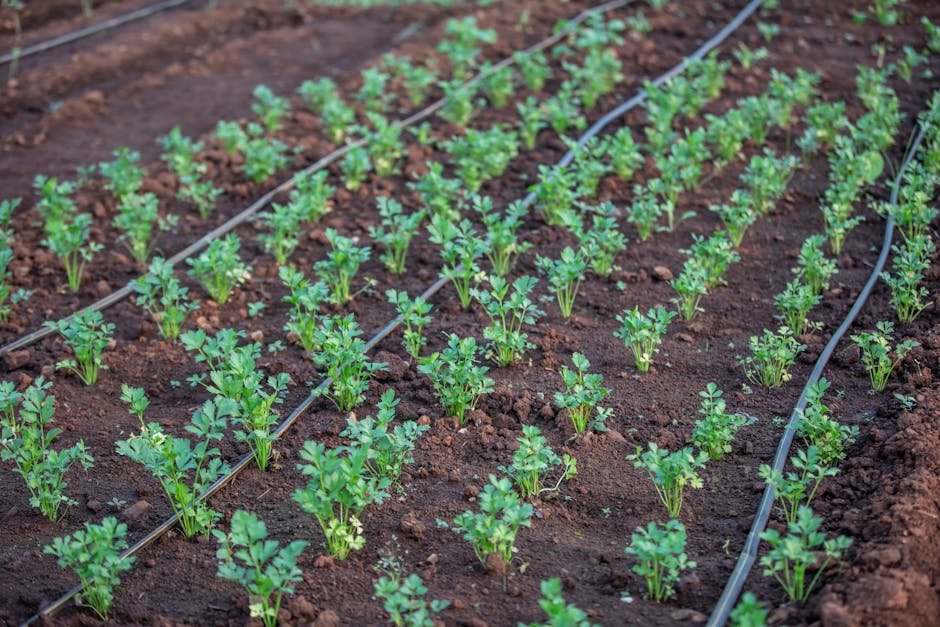
 Photo: Anil Sharma · Pexels License · source ↗
Drip fertigation in sugarcane
Drip fertigation in sugarcane — delivering irrigation water and water-soluble fertilisers through subsurface or surface drip lines laid along paired or wide-row cane plantings — is the single biggest water- and fertiliser-use efficiency intervention available to the Indian sugar industry. Vasantdada Sugar Institute Pune and ICAR-Sugarcane Breeding Institute have validated 25-35% water saving, 25-30% fertiliser saving and 20-30% cane yield increase versus conventional flood irrigation, with simultaneous gain of 0.5-1 percentage point in recovery.
Principle
Conventional flood- or furrow-irrigated cane needs 2200-3000 mm water per crop with 50-60% conveyance and application losses. Cane nutrient uptake follows a sharply peaked curve — heavy demand in the grand-growth phase (60-180 DAP) tapering at maturation. Conventional broadcast urea split into 2-3 doses leaks 30-50% to volatilisation, leaching and runoff before peak demand. Drip fertigation matches both water and nutrient supply to crop demand on a near-daily or alternate-day basis, eliminating the spike-and-stress cycle.
Procedure step-by-step
- Layout: paired-row planting at 30+150 cm or 30+120 cm; lay one 16-mm inline drip lateral per paired row with 30-40 cm emitter spacing (2-4 lph emitters). Surface drip is preferred for ratoonable plantings; subsurface drip (20-25 cm depth) for 4-5 year ratoon retention
- Headworks: sand filter + disc filter + ventury or fertiliser tank; pH 6.5-7.0 maintained with phosphoric or nitric acid; periodic acid wash to prevent calcium scaling
- Irrigation schedule: 6-8 lph/m emitter discharge applied at 80-100% of ET-Pan equivalent; daily run-time 30-90 minutes depending on stage and soil
- Fertigation schedule: total NPK split into 25-40 daily or alternate-day doses across the 8-10 month plant cane cycle. Typical: 250:115:115 kg NPK as urea + 19:19:19 + MOP + 13:0:45, with calcium nitrate substitution in acidic soils
- Trash mulching: trash blanket over drip lines reduces evaporation and protects pipes from rats
- Ratoon management: leave drip in place for 3-4 ratoons; flush lines after each harvest with chlorine 5 ppm and 35% HNO3 acid wash
When and where it applies
Drip fertigation is best suited to:
- Borewell-dependent peninsular cane (Maharashtra Solapur, Ahmednagar, Aurangabad; Karnataka Belagavi, Mandya; Tamil Nadu Erode; AP Chittoor, Anantapur)
- Saline or sodic borderline soils where flood irrigation accumulates salts in the root zone
- Premium varieties (Co 86032, Co 0238, CoM 0265) where yield bump pays back capital cost
- Adsali (18-month) Maharashtra plantings where total water demand crosses 3000 mm
National PMKSY-PDMC ("Per Drop More Crop") subsidies cover 55-80% of drip installation cost for small and marginal farmers; Maharashtra, Karnataka and TN have additional top-up schemes specifically for cane.
Limitations
- Capital cost of Rs 60,000-90,000 per hectare for surface drip and Rs 1-1.5 lakh for subsurface drip is the principal barrier, particularly for marginal farmers without subsidy access
- Borewell water with high carbonate and iron causes emitter clogging unless filtered and periodically acid-washed
- Subsurface drip is vulnerable to rat and white grub damage and harder to inspect
- Trash burning destroys drip pipes — trash mulching is mandatory, which conflicts with mill-led harvest mechanisation in some zones
- Power outages on borewell-fed drip can be catastrophic at grand-growth stage; storage tanks or solar pumps are recommended back-up
Related pages
See also: Sugarcane crop, Sugarcane bud-chip nursery, Sugarcane ratoon crop, Drip fertigation, Co 0238 sugarcane, Co 86032 sugarcane.
Sources
- Drip irrigation in sugarcane. Vasantdada Sugar Institute, Pune.
- Sugarcane production technology. ICAR-Sugarcane Breeding Institute, Coimbatore.
- PMKSY Per Drop More Crop guidelines. Ministry of Agriculture & Farmers Welfare.