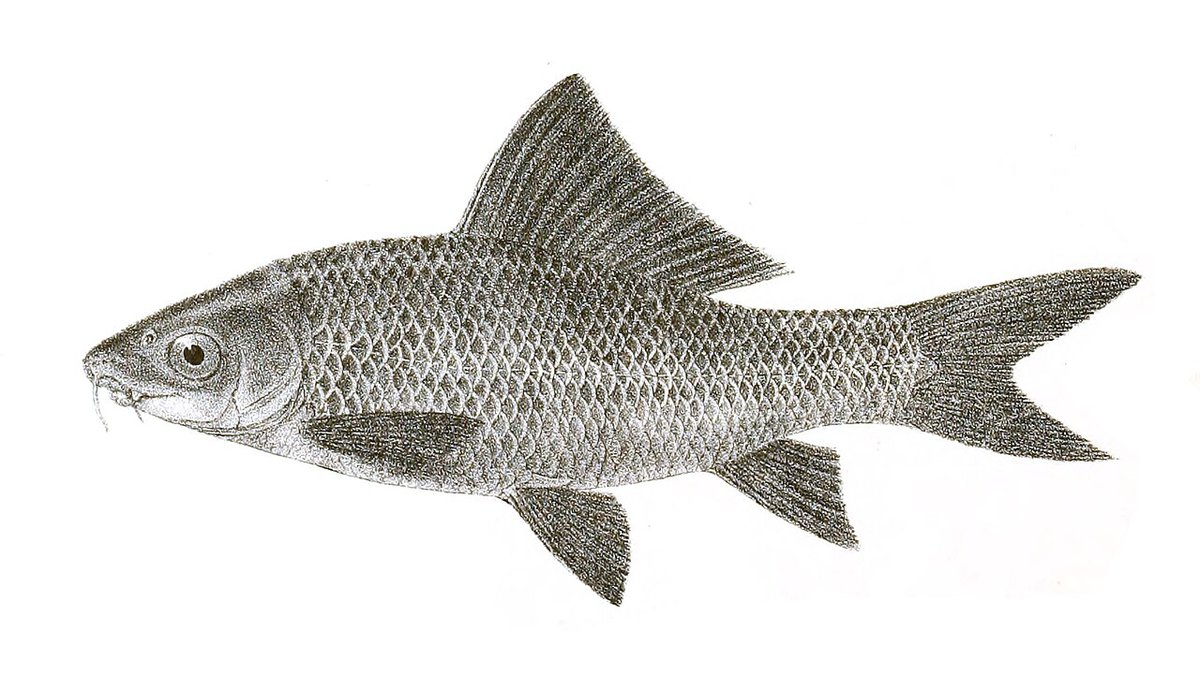
 Photo: Francis Day and R. Mintern · Public domain · source ↗

Calbasu (Labeo calbasu)
Calbasu (Labeo calbasu, also called black rohu or kalbasu) is an indigenous large minor carp of the Indian Major Carp family, native to the Indo-Gangetic, Brahmaputra and peninsular river systems. It is cultured on a moderate scale across eastern India as a bottom-column omnivore in polyculture and is highly valued in some local markets despite its dark colouration.
Key characteristics
- Family: Cyprinidae
- Body: dark grey to black, deep-bodied, slightly compressed; small inferior mouth with two pairs of barbels
- Feeding niche: bottom-column omnivore — feeds on detritus, periphyton, decaying vegetation, benthic invertebrates and plankton
- Growth: slower than rohu; reaches 500-800 g in 12 months
- Maximum size: about 90 cm and 10 kg
Cultivation
Calbasu is stocked in modest proportion (5-10%) in composite carp ponds alongside catla, rohu and mrigal in eastern India (Carp Polyculture Pond). It is induced-spawned in hatcheries using the standard carp pituitary or synthetic GnRH analogue (Ovaprim) protocol. Pond preparation follows standard methods (Fish Pond Construction). Calbasu accepts supplementary feed of rice bran and oilcake at 2-3% body weight. The species tolerates moderate water-quality variation and is hardier than rohu in low-oxygen ponds.
Pests and diseases
Calbasu is susceptible to argulosis (Carp Disease Argulus Anchor Worm), Aeromonas dropsy (Carp Disease Dropsy Aeromonas), EUS and gill rot. The species is reasonably hardy and disease incidence in well-managed ponds is comparable to or lower than mrigal.
Adoption and use
Calbasu is preferred in West Bengal, Bihar, Odisha, Assam and parts of Uttar Pradesh, especially among consumers who associate dark flesh with strong flavour. Whole-fish prices can equal rohu in these markets, although in southern India where calbasu is unfamiliar prices are lower. ICAR-CIFA promotes calbasu and other indigenous minor carps (kuria labeo, bata, fringed-lipped peninsular carp) under its aquaculture-diversification programme to reduce dependence on the catla-rohu-mrigal trinity. PMMSY supports pond development for diversification species.
Limitations
Growth is slower than rohu and mrigal, so per-pond yield is lower; calbasu is therefore a supplementary species rather than a primary stock. Consumer acceptance is regional — south-Indian markets give it a price discount. Breeding success in hatcheries is somewhat lower than for the major carps.
Related pages
See also: Rohu Labeo Rohita Imc, Mrigal Cirrhinus Mrigala Imc, Composite Fish Culture Six Species, Carp Polyculture Pond, Fish Pond Construction.
Sources
- Labeo calbasu. FishBase species summary.
- Indigenous minor carps for aquaculture diversification. ICAR-CIFA Bhubaneswar.
- Breeding biology of Labeo calbasu. KRISHI ICAR-CIFA.