 Photo: No machine-readable author provided. Hans B.~commonswiki assumed (based on copyr · Public domain · source ↗

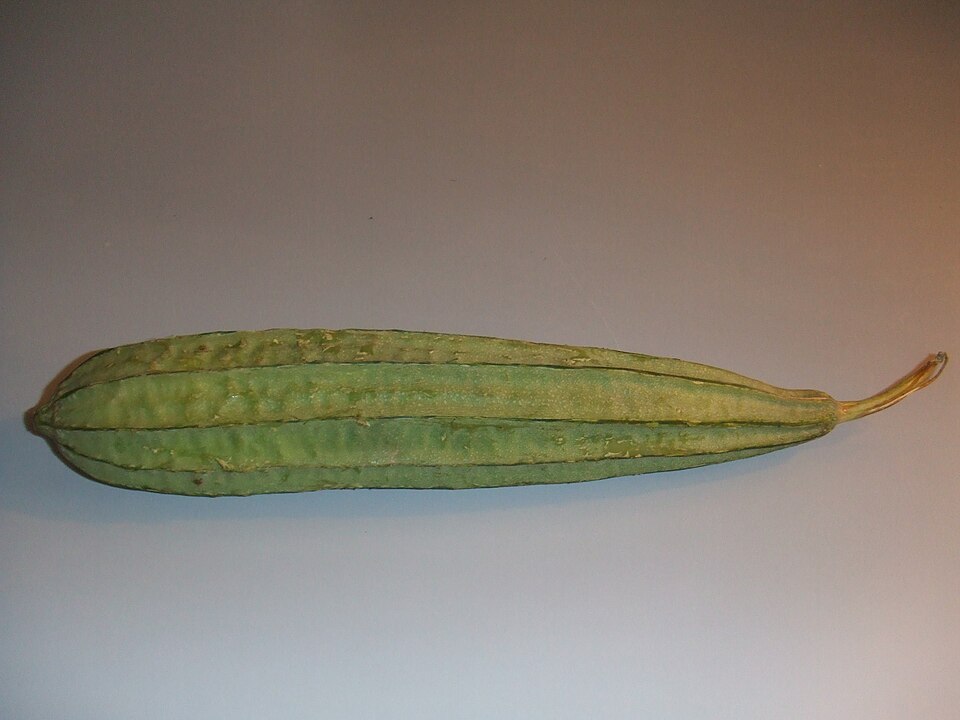
Ridge gourd (Luffa acutangula) / Beera
Ridge gourd (Luffa acutangula), known as beera in Telugu and turai in Hindi, is a fast-growing climbing cucurbit native to India and cultivated extensively across Asia for its immature ridged fruits. It is a staple summer and monsoon vegetable across south India.
Key characteristics
- Family: Cucurbitaceae
- Optimum temperature: 25-30 degC, warm and humid
- Habit: vine 3-5 m long, trellis/pandal-grown
- Harvest window: 2-3 months from sowing
Cultivation
Ridge gourd is suited to loam, clay-loam or silt soils with good drainage. Vines reach 3-5 m on pandals and trellises. Recommended organic-input rates are 2.5-5 t/ha of vermicompost or enriched compost with rock phosphate, supplemented with a biofertilizer consortium. Marketable yield is maximised by harvesting fruits while still tender; over-mature fruits become fibrous and are used only for seed extraction or as natural sponges (Luffa fibre).
Pest and disease profile
Ridge gourd is exposed to the cucurbit pest complex shared with Bottle Gourd, Bitter Gourd and Snake Gourd: fruit fly (Bactrocera cucurbitae), red pumpkin beetle, downy and powdery mildew, and viral mosaic diseases transmitted by aphids and whiteflies. Pheromone trapping is the standard front-line fruit fly management tool.
Adoption and use
Ridge gourd is grown by smallholders both as a kharif and summer crop, with seed-rate recommendations of around 600-800 g per acre under wide spacing (row 2.5-5 m x plant 40-80 cm). Both open-pollinated and private F1 hybrid varieties are available.
Related entries
See also: Bottle Gourd, Bitter Gourd, Snake Gourd, Ivy Gourd Dondakaya, Pumpkin Crop, Watermelon Crop, Teasel Gourd Aakakara, English Cucumber Polyhouse.
References
- Ridge Gourd (Luffa acutangula). KIRAN/ICAR.
- Organic Cultivation of Ridge Gourd. Current Journal of Applied Science and Technology.