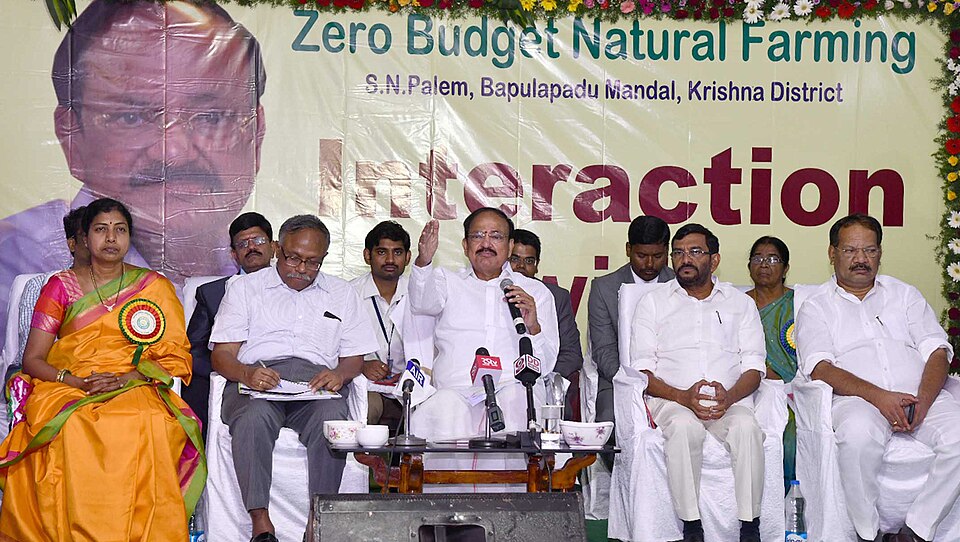
 Photo: Vice President's Secretariat · GODL-India · source ↗

Drava Jeevamrutham (liquid jeevamrutham)
Drava jeevamrutham is a liquid microbial inoculant central to Subhash Palekar Natural Farming (SPNF), Zero Budget Natural Farming (ZBNF) and the Andhra Pradesh Community Managed Natural Farming (APCNF) protocol. Unlike chemical fertilisers, it is applied not for its NPK content but as a culture of native soil microbes that activate nutrient cycling, with adequate residual carbon supplied through mulch and crop residue.
Composition and preparation
The standard recipe ferments the following in 200 litres of water:
- Desi cow dung: 5-10 kg
- Cow urine: 5-10 litres
- Jaggery: 1-2 kg
- Pulse flour (besan): 1-2 kg
- A handful of bund soil
The mixture is kept in shade for 48-72 hours under cover, with twice-daily stirring in a clockwise direction. The cured broth has a characteristic sweet-fermented smell and is used within a few days; longer storage degrades the active population.
Mode of action
The fermentation produces a high-density mixed population of nitrogen-fixing bacteria, phosphate solubilisers, lactic acid bacteria, yeasts and beneficial fungi sourced from the cow dung and bund soil, with jaggery and pulse flour as substrates. When applied to soil, this microbial culture is intended to establish in the rhizosphere and accelerate the mineralisation of soil organic matter and crop residue. The preparation is microbiological rather than nutritional in its mode of action.
Target use and dose
Applied at approximately 200 litres per acre as a soil drench or through irrigation water, typically every 15-30 days through the cropping season. Application is timed for moist soil so that microbes establish quickly. Best results are obtained when adequate mulch and crop residue are present to support the microbial population.
Adoption context
The preparation is the centrepiece of the APCNF/RySS programme in Andhra Pradesh, where it has been promoted to large numbers of farmers, and is also used in natural-farming systems in Karnataka, Himachal Pradesh and Maharashtra. Independent agronomic evidence is mixed and context-dependent.
Related entries
See also: Ghana Jeevamrutham, Jeevamrutham Orchard Input, Panchagavya, Vermiwash, Microbial Biofertilizers.
References
- Organic Fertilizer (Jeevamrit) and Beejamrit. LI-BIRD.
- Agriculture Department - APCNF Practices. West Godavari District, Government of Andhra Pradesh.