 Photo: Dr. Raju Kasambe · CC BY 4.0 · source ↗
.jpg)
Boer goat
Boer is a South African meat-type goat breed developed in the early 20th century from indigenous African goats with European, Indian and Angora introgressions. It is the world's most widely used commercial meat goat and is the principal exotic sire breed in Indian commercial goat farms for crossing with indigenous does (Osmanabadi, Sirohi, Black Bengal, Beetal, Jamunapari). The breed is not officially registered with the National Bureau of Animal Genetic Resources (NBAGR) but is regulated by the Department of Animal Husbandry and Dairying through embryo and semen import permits.
Origin and distribution
Boer was selected for meat production in the Eastern Cape of South Africa from around 1900 by Dutch settlers (Boere). The breed was imported to India in the 1990s, initially as embryos and frozen semen by private breeders and ICAR institutes. ICAR-CIRG Makhdoom, ICAR-NRC Meat Hyderabad, Sri Venkateswara Veterinary University and several private commercial breeders (notably in Andhra Pradesh, Telangana, Tamil Nadu and Maharashtra) have established Boer and Boer-cross nucleus herds. The pure Boer is now numerically small but Boer-cross goats are widely raised across peri-urban commercial farms.
Morphology
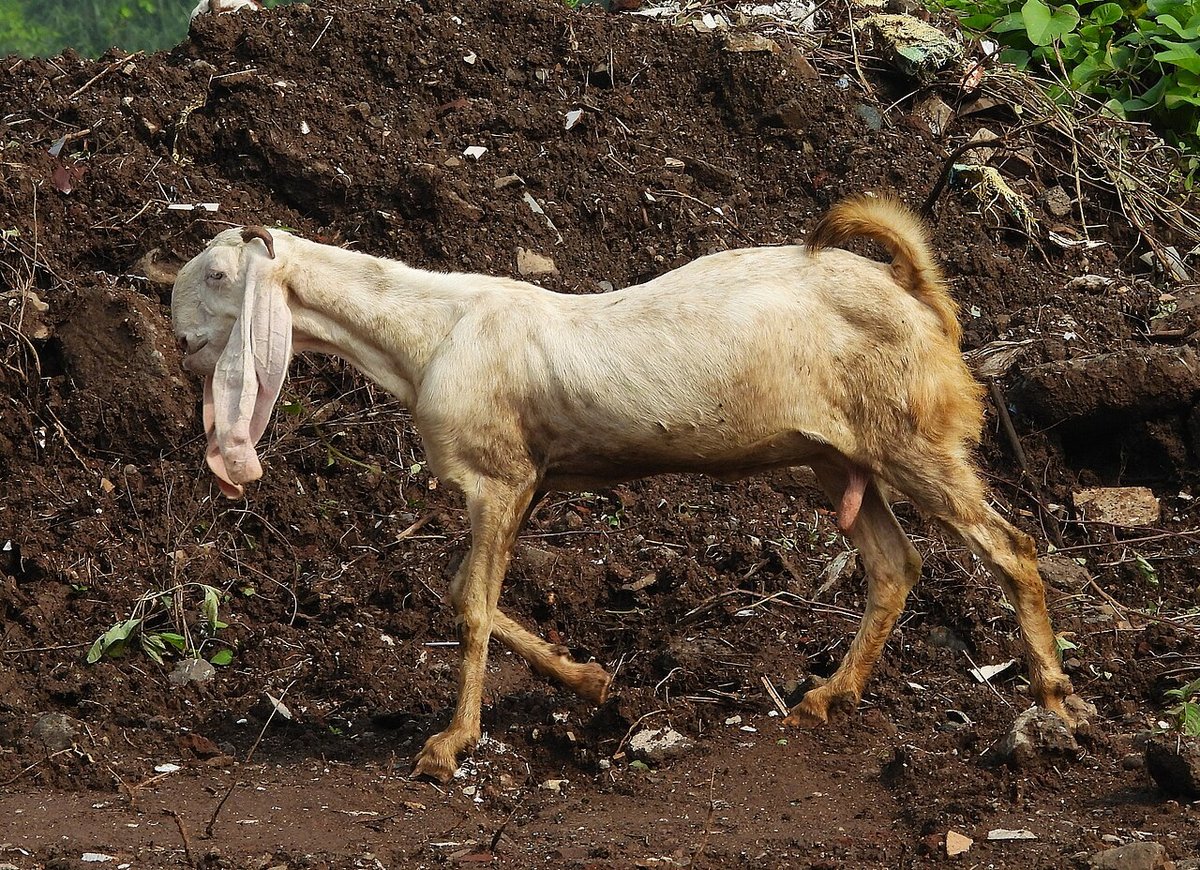
Boers are large, muscular goats with distinctive white body and red-brown head and neck (the "traditional" colour pattern). They have a Roman-nosed face profile, long pendulous ears, downward-sweeping horns and a deep loose-skinned body. Adult bucks weigh 110-135 kg and does 90-100 kg — roughly two to three times the live weight of indigenous Indian breeds. Kids are heavy at birth (3.5-4.5 kg) and gain weight at 250-350 g/day on good nutrition.
Performance
Boer's standout traits are growth rate and dressing percentage. Pure Boer kids reach 30-35 kg by 6 months on intensive feeding. Dressing percentage is 50-55 percent compared with 42-48 percent in indigenous breeds. Cross-breeding indigenous does with Boer bucks (50 percent Boer F1) typically increases kid weight at 6 months by 25-40 percent without losing parasite resistance or adaptability. Reproductive performance is moderate — twinning rate 30-50 percent, lower than Osmanabadi or Black Bengal but compensated by larger kid size.
Management
Boer and Boer-cross require better housing, parasite control and nutrition than indigenous breeds. Elevated slatted-floor sheds (Elevated Goat Sheep Shed) are standard in commercial Boer farms because the breed is susceptible to foot rot on wet floors. A balanced ration of 14-16 percent crude protein concentrate plus green fodder (Hedge Lucerne, Hybrid Napier, Subabul) is needed to express genetic potential. Quarterly deworming and full implementation of the small-ruminant vaccination schedule (small-ruminant-vaccination-schedule) against PPR, FMD, ET and goat pox are essential. Boer-cross stock fits the Bakrid ram-fattening market (Ram Fattening Bakrid) well because of its rapid weight gain.
Limitations
Pure Boer is not well adapted to tropical heat and high parasite load — pure Boer kids show higher pre-weaning mortality than indigenous kids in extensive systems. The breed needs intensive rearing, good shelter and disease control. Pure Boer breeding stock is expensive (Rs 50,000-2,00,000 per buck), restricting access to commercial farms; the practical strategy for smallholders is to source Boer-cross F1 bucks from established breeders.
Related entries
See also: Osmanabadi goat, Black Bengal goat, Sirohi goat, Elevated Goat Sheep Shed, Sheep and goat vaccination schedule.
Sources
- Boer goat breed standard. South African Boer Goat Breeders' Association.
- Performance of Boer cross goats in India. ICAR-Central Institute for Research on Goats.
- Boer goat cross-breeding programmes. ICAR-NRC on Meat.