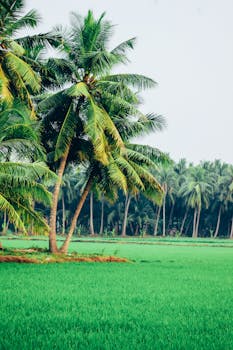
 Photo: Prathyusha Mettupalle · Pexels License · source ↗
Ceylon Yellow (Siloni) coconut
Ceylon Yellow, also called Siloni or Siloni Yellow, is a tall coconut introduction from Sri Lanka belonging to the Typica group (Sri Lanka Tall). It is grown in India alongside indigenous talls such as West Coast Tall and East Coast Tall, and Sri Lankan tall material features in ICAR-CPCRI and Coconut Development Board germplasm collections.
Key characteristics
- Origin: Sri Lanka (Typica group, Sri Lanka Tall)
- Average yield: around 12,000 nuts/ha/year
- Copra per nut: approximately 225 g
- First flowering: 6-7 years after planting
- Traits: strong drought tolerance and good disease resistance among Indian coconut conditions
Cultivation
Seed nuts are raised in nurseries for around a year before transplanting. CPCRI and Coconut Development Board recommendations specify wide spacing (around 7.5 m, equivalent to roughly 24 ft) to give each palm adequate sunlight and air movement. Mature plantings benefit from regular manuring, basin irrigation or drip, and pest surveillance. The variety crops well into its second decade and palms continue to bear for over 60 years.
Pest and disease profile
Like other talls, Ceylon Yellow is susceptible to the red palm weevil (Red Palm Weevil) and rhinoceros beetle (Rhinoceros Beetle Palm Pest), which are managed through pheromone traps, sanitation and biocontrol. Stem-bleeding and bud-rot also occur in poorly drained conditions.
Adoption and use
The variety produces general-purpose nuts suited for tender water, copra and oil. Husk from the harvest enters the coir economy (Coir Cocopeat Industry) as fibre and cocopeat. Sri Lankan tall material is also used as a parent in cross-breeding programmes with dwarf varieties such as Gangabondam (Coconut Kerala Bondam Dwarf) to produce hybrid coconuts.
Related entries
See also: Coconut Kerala Bondam Dwarf, Coir Cocopeat Industry, Red Palm Weevil, Rhinoceros Beetle Palm Pest.
References
- Improved coconut varieties and hybrids. Coconut Research Institute, Sri Lanka.
- Improved Varieties of Coconut, Arecanut and Cocoa. ICAR-CPCRI.