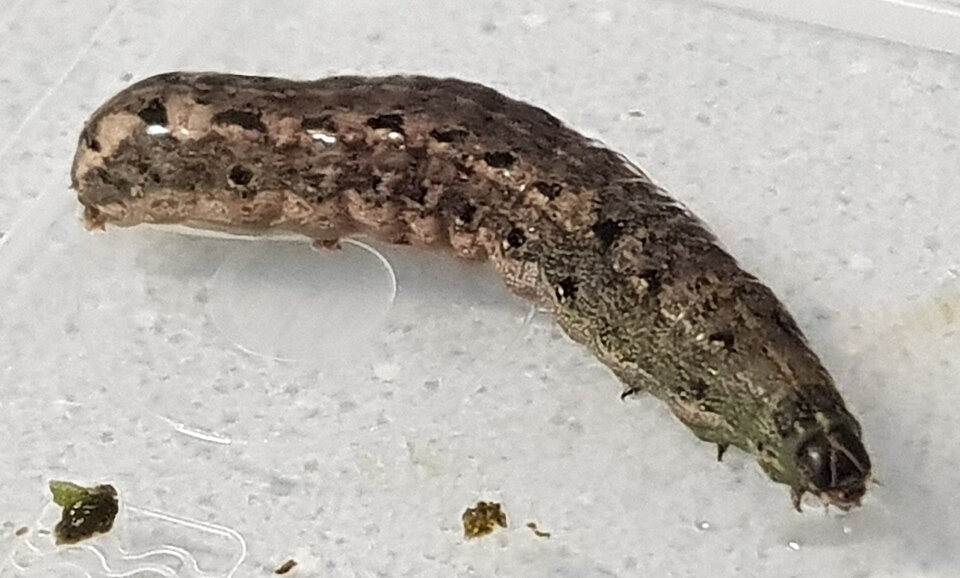
 Photo: M. de Lisle · CC BY-SA 4.0 · source ↗

Leaf-eating and fruit-borer caterpillars in chilli
Two lepidopteran caterpillars are the dominant chewing pests of Indian chilli: the tobacco caterpillar Spodoptera litura (Noctuidae), which defoliates plants in gregarious early-instar swarms, and the fruit borer Helicoverpa armigera, which bores into chilli pods near the stalk.
Identification and symptoms
S. litura produces patchy defoliation with characteristic 'shot-holed' leaves in early instars and large leaf-blade losses as later instars disperse. H. armigera bores into ripening pods near the stalk, leaving entry holes and frass.
Host crops / Life cycle
Both species are highly polyphagous and have multiple generations per crop cycle. S. litura belongs to the family Noctuidae; H. armigera is also noctuid and is the same fruit borer that attacks cotton, pigeonpea and tomato in Indian cropping systems.
Damage and economic impact
TNAU and NIPHM IPM modules report combined damage of 30-40% yield loss in unmanaged fields.
Management (cultural, biological, chemical)
- Monitoring — pheromone trapping at 12 traps/ha (TNAU)
- Trap crop — marigold border / interplant rows
- Biocontrol — nucleopolyhedrovirus (NPV) biopesticide sprays
- Chemistry — emamectin benzoate, chlorantraniliprole and flubendiamide for high-pressure windows
- Calendar fit — caterpillar-active sprays are placed in the mid-stage of the IPM schedule (Practice Chilli Spray Schedule)
These management slots are coordinated with sucking-pest (Pest Sucking Pests Chilli) and thrips (Pest Thrips Parvispinus Black Thrips) sprays so that chemistry rotation across modes of action is preserved.
Related entries
Practice Chilli Spray Schedule, Pest Thrips Parvispinus Black Thrips, Pest Sucking Pests Chilli
References
- Gram caterpillar Helicoverpa armigera on chilli. TNAU Agritech.
- AESA-based IPM Chilli/Capsicum. NIPHM.