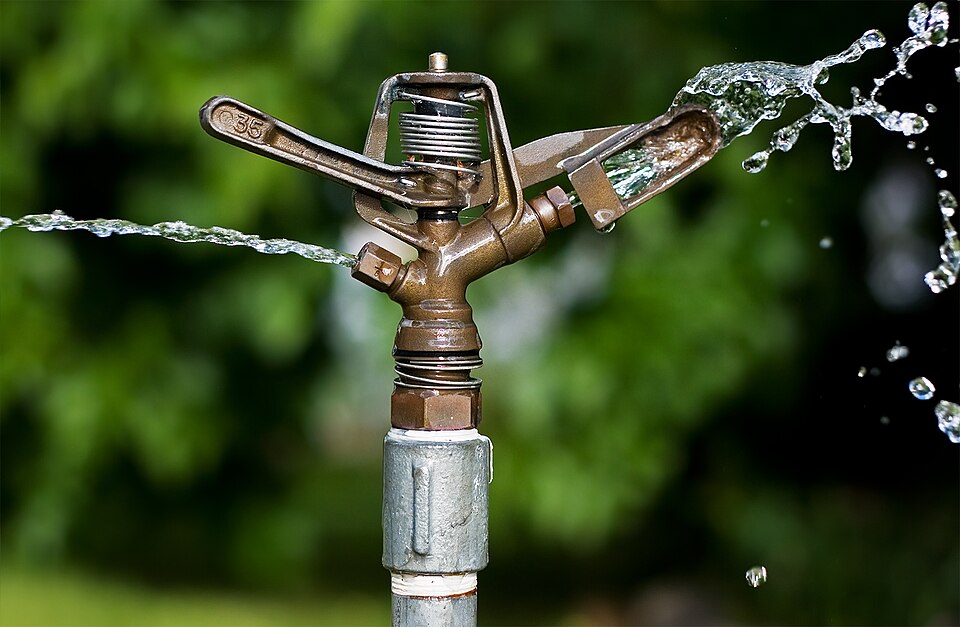
 *Photo: JJ Harrison (https://www.jjharrison.com.au/)
If you enjoy my work, and wo · CC BY-SA 3.0 · source ↗*

Sprinkler irrigation
Sprinkler irrigation is a pressurised micro-irrigation method that distributes water through HDPE or PVC mains to riser-mounted impact or rotary heads, producing a rain-like spray over the crop canopy. It suits crops grown at close spacing on undulating terrain and is well adapted to plots served by low-yielding borewells that cannot sustain flood irrigation.
Principle
A pump pressurises water through buried or surface mains to vertical risers fitted with impact or gear-driven rotary sprinklers. The rotating nozzles cast water in overlapping circles, the radius of throw depending on operating pressure and nozzle bore. Spray covers the soil surface uniformly, reducing the channelling losses associated with surface flow.
Implementation
A standard sprinkler set comprises a pump, screen filter, PVC mains and laterals, quick-coupling risers and impact sprinkler heads. Heads are advanced across the field in sequence, irrigating a block at each setting. Like Drip Irrigation, sprinkler systems are eligible under the Per Drop More Crop (PDMC) component of PMKSY, which provides 55% assistance to small and marginal farmers and 45% to other farmers, capped at 5 hectares per beneficiary. ICAR Krishi Vigyan Kendras run on-farm demonstrations to popularise the technique.
Adoption context
Sprinklers are commonly used in India for wheat, groundnut, pulses, fodder, vegetables and grass crops. On groundnut, a 5-acre rotation typically completes in 4-5 days with 10-15 set changes, operated by two labourers. On rabi wheat in heavy soils, five to six sprinkler events through the season cover germination, tillering and grain-fill needs. High-discharge variants for larger blocks are described separately under Rain Gun Irrigation.
Limitations
Application uniformity is reduced by wind, and evaporation losses are higher than in Drip Irrigation. Foliar wetting can favour leaf diseases in dense canopies. Energy requirement is higher than for drip because of the higher operating pressure, and saline irrigation water may scorch leaves during spray.
Related entries
See also: Drip Irrigation, Fertigation, Rain Gun Irrigation, Automatic Drip Irrigation, Paddy Water Management.
References
- Operational Guidelines of Per Drop More Crop (Micro Irrigation). PMKSY.
- PMKSY factsheet. Press Information Bureau, 2022.
- National Mission on Micro Irrigation Guidelines. National Committee on Plasticulture Applications in Horticulture.