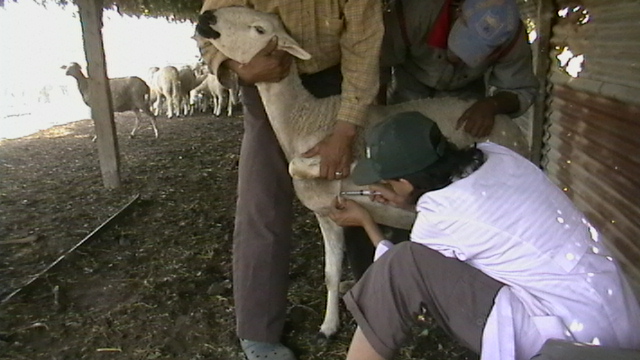
 Photo: Lucyin · CC BY-SA 4.0 · source ↗

Sheep and goat vaccination schedule
The annual vaccination schedule for small ruminants is the structured calendar of immunisations against the principal endemic infectious diseases of Indian sheep and goats: peste des petits ruminants (PPR), foot-and-mouth disease (FMD), haemorrhagic septicaemia (HS), sheep pox, goat pox and enterotoxaemia (ET). The schedule is published by ICAR-Indian Veterinary Research Institute (IVRI) Bareilly and is the operational basis for state animal-husbandry departments and commercial breeders.
Principle
Endemic small-ruminant diseases follow either an age-structured (clostridial, pox) or a seasonal (FMD, PPR, HS) pattern. A calendar-based schedule ensures every animal receives primary and booster doses at the age and season when antibody response is best and protection is needed most. Targeted control of PPR is delivered nationally under the Department of Animal Husbandry and Dairying's National Animal Disease Control Programme.
Implementation
The standard ICAR-IVRI calendar prescribes:
- PPR — single dose at 3 months of age, booster every 3 years. PPR vaccine confers long-lasting immunity, and a one-shot strategy fits well with extensive flocks.
- FMD — primary dose at 3 months of age, booster 3-4 weeks later, then revaccination every 6-12 months depending on regional risk.
- Sheep pox (and analogous goat-pox vaccine) — primary at 3-5 months of age, annual revaccination; given in sheep only for sheep pox and in goats for goat pox.
- Haemorrhagic septicaemia (HS) — primary at 3-5 months of age, annual revaccination, ideally before monsoon onset.
- Enterotoxaemia (ET) — primary doses before weaning, followed by annual boosters in flocks at risk.
Deworming with an appropriate broad-spectrum anthelmintic is recommended 7-14 days before any vaccination to ensure the animal mounts a strong immune response. Cold-chain integrity from the district veterinary store to the field vaccinator is critical for vaccine efficacy.
Adoption context
The schedule applies uniformly to indigenous breeds such as Nellore sheep (Nellore Sheep), Osmanabadi goat (Osmanabadi Goat) and Black Bengal goat (Black Bengal Goat), to ram lambs being fattened for festival markets (Ram Fattening Bakrid), and to stationary commercial flocks in elevated slatted-floor sheds (Elevated Goat Sheep Shed). Bluetongue (Bluetongue Sheep) is managed separately with an attenuated polyvalent vaccine before the monsoon.
Limitations
Migratory transhumant flocks (Migratory Sheep Grazing) are hard to reach with a calendar-based schedule because the flock is rarely in one administrative district through the vaccination window. State veterinary services run special mobile camps along migration routes to bridge the gap, but coverage remains uneven.
Related entries
See also: Bluetongue Sheep.
References
- Vaccination and Annual Health Calendar for Sheep and Goat. ICAR-Indian Veterinary Research Institute.
- Vaccines for Livestock and Poultry. Indian Council of Agricultural Research.