 Photo: KVDP · CC BY-SA 3.0 · source ↗

Anaerobic bio-digester jeevamrutham
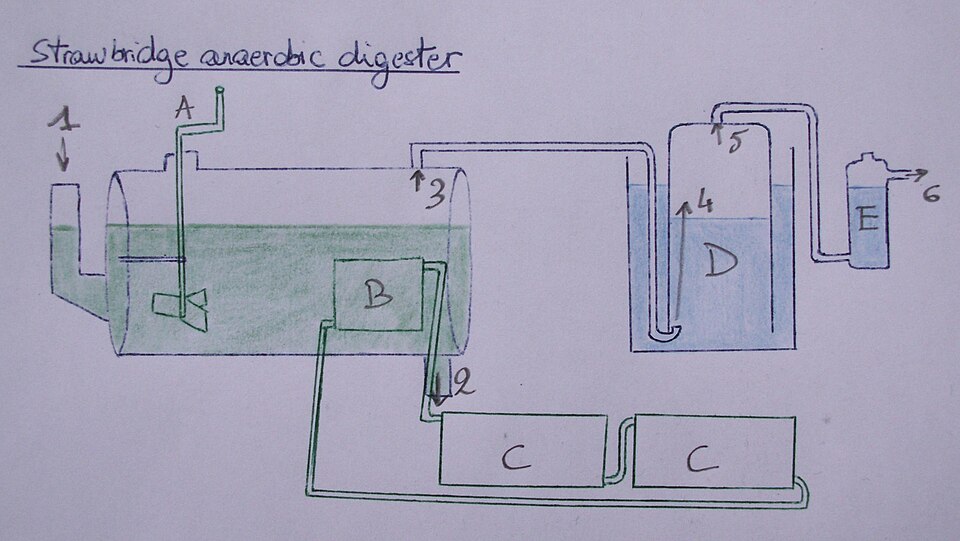
Anaerobic bio-digester jeevamrutham is a closed-tank adaptation of the traditional open-drum jeevamrutham preparation used in natural farming. Sealed HDPE or LLDPE tubular digesters ferment cow dung, cow urine, jaggery and pulse flour without aeration, producing a continuously-tappable liquid microbial brew compatible with drip systems.
Principle
Conventional jeevamrutham is prepared in open drums and stirred twice daily during a 48-72 hour aerobic fermentation. The closed-tube variant flips the chemistry to anaerobic digestion: the same ingredients ferment in a sealed reactor where biogas is captured as a co-product and evaporation losses are eliminated. The output is a filtered, low-particulate liquid suitable for fertigation through micro-irrigation emitters without clogging.
Implementation
Commercial units use HDPE or LLDPE tubular tanks ranging from 1,700 to 4,500 L capacity, yielding 75 to 300 L/day of filtered liquid biofertiliser depending on tank size and feed rate. The sealed design produces biogas as an anaerobic by-product that can be piped to a kitchen burner. Continuous-output design supports daily fertigation rather than the batch cycle imposed by open drums.
Adoption context
Anaerobic units have been adopted in Gujarat, Maharashtra (notably Nashik) and other natural-farming clusters where farmers seek to integrate jeevamrutham with drip fertigation on horticultural blocks. The tube-digester format reduces the labour intensity that historically constrained natural-farming systems at scale.
Limitations
Capital cost is significantly higher than open-drum preparation, requiring farm-scale financing. Anaerobic digestion suppresses some aerobic microbial populations associated with the original Palekar recipe, and the technique sits outside the strict ZBNF doctrine even when used to produce a similar brew. Continuous feeding discipline is required to maintain output volumes.
Related entries
See also Zbnf Zero Budget Natural Farming, In Situ Residue Decomposition and Drip Fertigation.
References
- Advance Jivamrut Tube System. Industry technical literature.