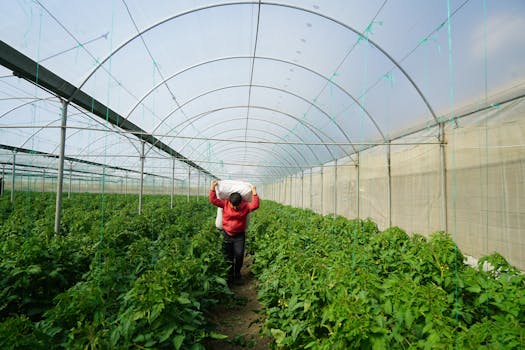
 Photo: Cemil Gokmen · Pexels License · source ↗
Polyhouse / shade-net protected vegetable cultivation
Polyhouse and shade-net protected cultivation refers to enclosed or semi-enclosed structures that extend the growing window for high-value vegetables by moderating temperature, humidity, light intensity and pest pressure. Naturally-ventilated polyhouses use UV-stabilised polyethylene film over a galvanised steel frame; shade-net houses use polypropylene mesh of varying shade percentage.
Principle
Open-field cultivation of off-season or high-value vegetables fails on heat stress, monsoon damage or insect pressure that the local agro-climate imposes. A polyhouse buffers internal temperature and humidity through controlled ventilation; a shade-net house cuts incident solar radiation to a level the crop tolerates. Both structures exclude flying insect pests when fitted with insect-proof side nets, reducing dependence on foliar insecticides. Internal microclimate enables year-round production of crops that would otherwise be limited to a narrow seasonal window.
Implementation
MIDH subsidy through the National Horticulture Board covers 50 percent of structure cost for general farmers and up to 60 percent for SC/ST growers under the protected-cultivation component. Standard shade-net configurations use 35-75 percent shade percentage selected by crop. Standard cropping plans include coloured capsicum from July to March followed by cucumber, or beans-tomato-cucumber rotation under shade net. Drip fertigation and plastic mulch are integral.
Adoption context
Protected cultivation is the standard production system for coloured capsicum, English cucumber, off-season tomato, exotic leafy greens, gerbera, carnation and rose for cut-flower production. It is concentrated in peri-urban clusters around Bengaluru, Pune, Nashik, Hyderabad and Chennai. Andhra Pradesh, Karnataka, Maharashtra, Tamil Nadu and Himachal Pradesh have active state-level promotion.
Limitations
Initial capital cost is substantial (Rs 10-50 lakh per acre depending on type), and farmer share even after subsidy is significant. Structural failure under high winds or heavy hail is a recurrent risk. Climate control within naturally-ventilated houses depends on operator skill; mismanaged ventilation triggers disease outbreaks. Crop choice is constrained by economic return per square metre, ruling out commodity vegetables.
Related entries
See also Low Tunnel Shade Net, Drip Fertigation Vegetables, Ipm Vegetables and Mulching Vegetables.
References
- Guidelines for Protected Cultivation. Department of Horticulture, Government of Andhra Pradesh.
- NHB Polyhouse Subsidy Complete Guide. Industry summary of NHB scheme.