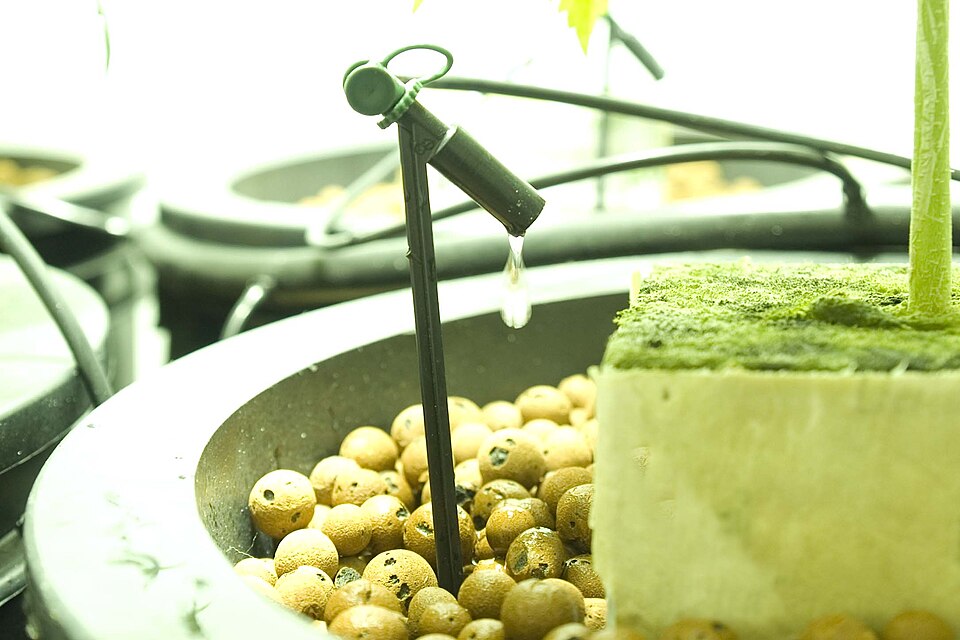
 Photo: Alan.ca · Public domain · source ↗

Drip emitter clogging and unclogging
Emitter clogging is the principal failure mode of drip systems and reduces application uniformity long before complete blockage occurs. Three mechanisms are recognised: physical clogging by suspended sediment, chemical clogging by carbonate or sulphate scale and fertiliser precipitates, and biological clogging by algal and bacterial biofilms.
Identification
Symptoms include visibly reduced or zero discharge from individual emitters, uneven wetting patterns along a lateral and falling pump pressure recovery between irrigation events. Physical clogs typically appear in clusters at the lateral end; chemical scaling spreads progressively from the emitter inlet; biological biofilms form a slimy layer that lifts off during flushing.
Management
Four standard practices, recognised in peer-reviewed work and in extension manuals, form the basis of emitter clog control. First, adequate inlet filtration through sand, disc or screen filters appropriate to the water source. Second, periodic flushing of laterals by opening the end caps and letting suspended material discharge under full pressure. Third, chemical acidification using hydrochloric or phosphoric acid to bring water pH to about 3-5, dissolving carbonate scale. Fourth, chlorination at 2-10 mg/L free chlorine on a 4-8 week interval to keep biofilms below the re-clogging threshold. Acid washing is generally applied at season-end for chemical scale, while chlorination is repeated through the season for biofilm control.
Prevention context
Water source quality drives the relative importance of each control. Surface ponds and recycled water carry biological load and benefit most from chlorination; calcareous groundwater and fertigation lines are prone to chemical scaling. Fertigation with non-compatible salts (Fertigation) accelerates precipitation inside emitters. System hydraulic design that maintains adequate flushing velocity at the end of each lateral reduces sediment accumulation.
Related entries
See also: Drip Irrigation, Fertigation, Automatic Drip Irrigation, Sprinkler Irrigation.
References
- Prevention and treatment of drip emitter clogging - review. Water Practice and Technology, IWA Publishing.
- Reducing clogging using acid washing and ultrasonic technology. Scientific Reports, Nature.
- Optimal acid and chlorine addition for biogas slurry drip. Agriculture, MDPI.