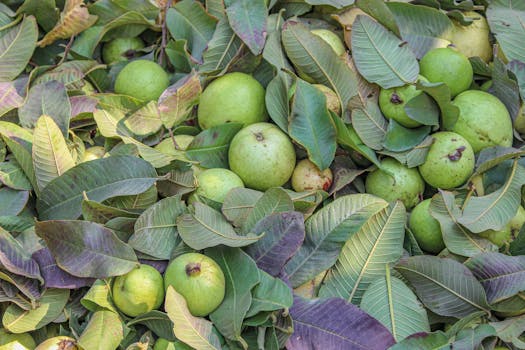
 Photo: Zaryab Haider · Pexels License · source ↗
Annual guava pruning and crop cycling
Guava (Psidium guajava) bears fruit on the current season's growth, so canopy pruning is the principal lever by which orchards control fruit number, fruit size, harvest timing and tree height. Pruning research at ICAR-CISH Lucknow has standardised a two-pulse pruning calendar that is now widely used in commercial guava plantings in India.
Principle
Heading back and hedging cuts force new shoots that flower and set fruit within a predictable window. By concentrating pruning into selected months, growers can suppress the lower-quality rainy crop and push the orchard toward a single, heavy winter crop with better fruit quality, lower pest pressure and higher market prices.
Implementation
ICAR-CISH research indicates that two pruning events per year are most effective:
- May pruning: heading back to manage tree height (reductions of 34-43% reported under standard trials) and remove the summer crop to redirect energy.
- October pruning: light hedging to shape canopy and prepare for the winter crop.
Cuts are made 25-30 cm from previous-season terminals, and wounds are smeared with Bordeaux paste or copper oxychloride to prevent fungal entry. Drip and balanced fertigation accompany the pruning calendar. In CISH trials, hedging delivered around 82 kg/plant in Allahabad Safeda (Guava Allahabad Safeda) and around 53 kg/plant in Sardar a year after pruning.
Adoption context
The pruning-cycle approach underpins high-density guava plantings at spacings of 2 x 1, 2 x 2, 3 x 3 and 3 x 6 m, and is used with both classical cultivars and newer high-yielding lines such as Taiwan Pink (Guava Taiwan Pink) and CISH Lalit.
Limitations
Aggressive pruning can lead to sunburn on exposed branches in summer and creates entry points for stem borers and mealybug (Mealybug Orchard Pest) if cuts are not properly protected. Timing must be synchronised with local weather; pruning too close to monsoon onset can trigger uncontrolled flushing and disease.
Related entries
See also: Guava Allahabad Safeda, Guava Taiwan Pink, Mealybug Orchard Pest.
References
- High Density Orcharding in Guava. ICAR-CISH Lucknow.
- Guava varieties. ICAR-CISH Lucknow.