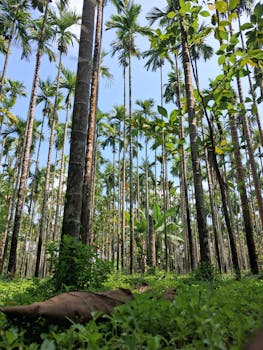
 Photo: Charan Shetty · Pexels License · source ↗
Areca-under-coconut intercrop system
The areca-under-coconut intercrop system is a multi-tier plantation layout in which mature coconut palms form the top tier and arecanut, with black pepper, cocoa, banana, turmeric or pineapple in lower tiers, occupies the inter-row space. The design exploits the light, root and biomass profile of widely-spaced coconut to add second and third revenue streams without displacing the main crop.
Principle
Mature coconut on 7.5-9 m (25-27 ft) square spacing leaves roughly 60 percent of incident sunlight reaching the inter-row floor by mid-life. Arecanut, planted at 2.7 m (9 ft) triangular spacing in this gap, uses the residual light efficiently. Lower tiers — pepper trained on the trunks, banana on the bund, turmeric and pineapple at ground level — partition the soil profile and the canopy and recycle nutrients across species.
Implementation
ICAR-CPCRI Kasaragod has standardised the multi-tier package with coconut at the top, arecanut and banana in the middle tier and black pepper, turmeric or pineapple in the lower tier. Documented in-field biomass recycling alone is 8.72 to 10.35 t/ha/year of plant residue from the arecanut multi-tier, returning carbon and nutrients to soil. Intercropping coconut with medicinal and aromatic plants has been shown to lift system productivity by 11 to 53 percent over coconut monoculture.
Adoption context
The system is the dominant smallholder plantation pattern in coastal Karnataka, Kerala and parts of Andhra Pradesh and Tamil Nadu, where land holdings are small and farmers cannot afford to depend on a single crop. ICAR-CIWA documents the model as a coconut-based multi-storey cropping system suitable for humid coastal agro-ecologies.
Limitations
Layout once established is difficult to change because arecanut and pepper are long-duration crops. Heavy biomass recycling demands continuous shredding labour, and waterlogging in poorly-drained sites can damage the shallow-rooted arecanut.
Related entries
See also Intercrop Oil Palm Young, Legume Intercropping Orchards and Turmeric Ginger Papaya Maize Rotation.
References
- Plantation Crops Research. ICAR-Central Plantation Crops Research Institute, Kasaragod.
- Coconut-based multi-storey cropping model. ICAR-CIWA Gender Knowledge System.