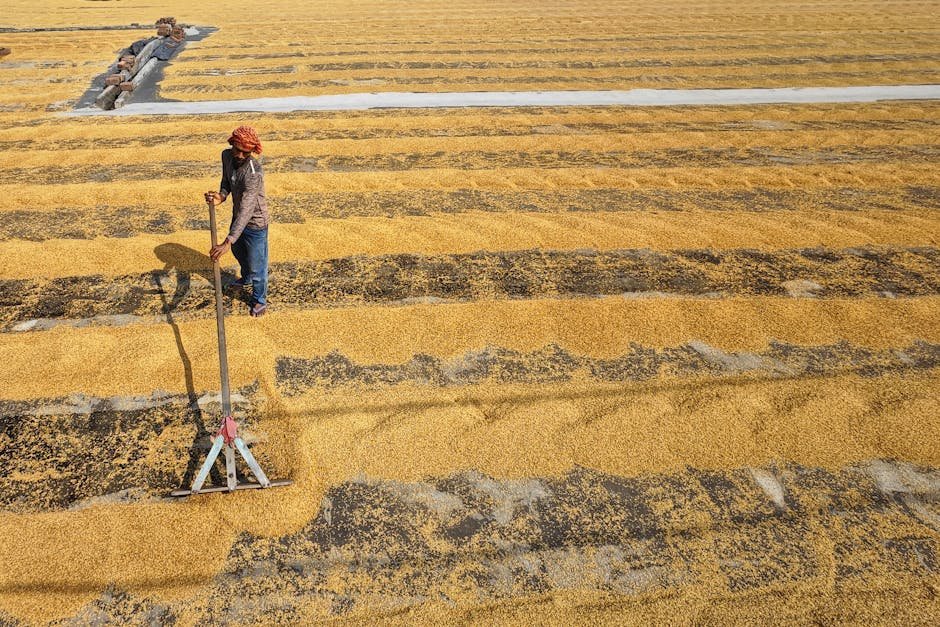
 Photo: Dibakar Roy · Pexels License · source ↗
MSP 23 notified crops coverage list
The Minimum Support Price covers 22 mandated crops plus sugarcane under the separate statutory Fair and Remunerative Price (FRP) mechanism — together referred to as the 23 MSP crops. The Commission for Agricultural Costs and Prices (CACP) recommends MSPs for these crops twice a year and the Cabinet Committee on Economic Affairs (CCEA) approves them before the start of the respective marketing season.
The 7 cereals (kharif and rabi)
CACP recommends MSP for seven cereals: paddy (common and Grade A), wheat, maize, jowar (sorghum — hybrid and maldandi), bajra (pearl millet), ragi (finger millet) and barley. Paddy and wheat are the only cereals with deep procurement infrastructure — over 90 percent of MSP procurement value flows to these two crops. The coarse-cereal MSPs are largely advisory in most states.
The 5 pulses
The five pulse crops with notified MSP are tur/arhar (red gram), moong (green gram), urad (black gram), chana (chickpea) and masur (lentil). NAFED is the central nodal agency for pulse procurement under the Price Support Scheme (PSS); kharif pulses are procured October-January, rabi pulses April-July.
The 7 oilseeds
The seven oilseed crops with notified MSP are groundnut, soybean, sunflower, sesamum (til), safflower, rapeseed-mustard and niger seed. NAFED is again the central agency for procurement, with state-level partners like APMARKFED (Andhra Pradesh), MARKFED (Telangana), and KAPPEC (Karnataka).
The 4 commercial crops
Four commercial crops complete the basket:
- Cotton (medium-staple and long-staple) — procured by the Cotton Corporation of India (see CCI cotton procurement)
- Raw jute — procured by the Jute Corporation of India (JCI)
- Copra (milling and ball) — procured by NAFED
- Sugarcane — covered by the statutorily binding Fair and Remunerative Price (FRP) recommended by CACP and notified under the Sugarcane (Control) Order 1966; states may declare a higher State Advised Price (SAP)
Notable exclusions
- All horticultural crops — tomato, onion, potato, banana, mango, citrus etc. (covered by MIS when the state requests)
- Spices (chilli, turmeric, coriander, cumin) — no MSP
- Tea, coffee, rubber, coconut (outside MIS, FRP)
- Fodder crops, livestock, poultry, fisheries produce
- Tobacco
Marketing season timing
Kharif-marketing-season MSPs are announced in May-June for kharif paddy, oilseeds, cotton and pulses harvested October-January. Rabi-marketing-season MSPs are announced October-November for wheat, mustard, chana, masur, barley harvested April-June. Sugarcane FRP is announced separately before the October-September sugar season.
Limitations of the 23-crop basket
The MSP basket excludes the majority of India's gross cropped value — fruits, vegetables, spices, milk, fish and meat all sit outside. Even within the basket, procurement coverage is uneven: paddy and wheat see large physical procurement, cotton and sugarcane see indirect intervention via CCI and FRP-mill payment respectively, while coarse cereals, most pulses and minor oilseeds see only token procurement in select states.
Related pages
See also: MSP — Minimum Support Price, MSP formula A2/A2+FL/C2, CACP, FCI procurement mechanism, Price Support Scheme.
Sources
- MSP recommendations. Commission for Agricultural Costs and Prices.
- MSPs for kharif marketing season 2025-26. Press Information Bureau.
- MSPs for rabi marketing season 2025-26. Press Information Bureau.