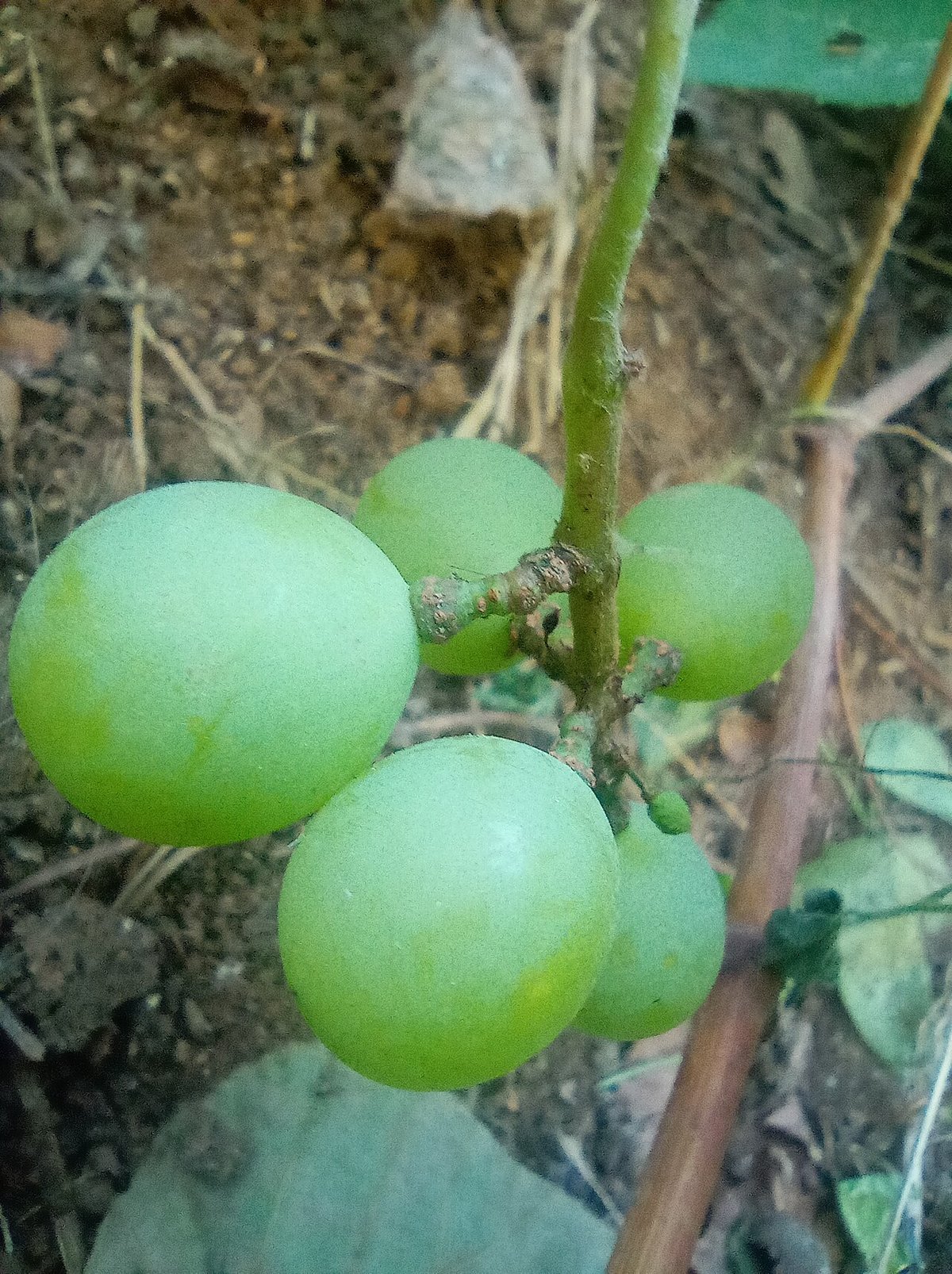
 Photo: Advcravikumar · CC BY-SA 4.0 · source ↗

Anab-e-Shahi grape
Anab-e-Shahi (literally "royal grape") is the traditional seeded table grape of the Telangana / north Andhra grape belt. Believed to have been introduced from West Asia during the Asaf Jahi period, it was for several decades the dominant Indian table-grape variety, especially around Hyderabad, before Thompson Seedless overtook the export market in the 1990s.
Key characteristics
- Berry: large, oval to elliptical, light-yellow to amber at full maturity
- Seeds: 2-4 per berry (seeded)
- TSS at harvest: 14-17 deg Brix
- Bunch weight: 600 g - 1.2 kg; large, loose, conical
- Harvest window: February to April in Ranga Reddy / Medak; later in cooler tracts
- Yield: 8-12 t/ac on well-trained pandal trellises
- Pulp: crisp, juicy, mildly sweet; lower TSS but higher acidity than Thompson Seedless
Cultivation
Anab-e-Shahi is vigorous and prefers the deep, well-drained alfisol soils of the Hyderabad-Medchal-Ranga Reddy belt. It is traditionally trained on the flat overhead pandal (bower) system with wide spacing (3 x 3 m or 3.5 x 3.5 m) to accommodate its strong vegetative growth. Single annual pruning in October-November is common, in contrast to the double-cycle protocol used for Thompson Seedless (Grapes Pruning Back Foreward). The variety tolerates a wider range of soils than Thompson Seedless but yields are improved on Dogridge or 110R rootstocks (Grapes Rootstock Dogridge 110R) under saline or nematode-prone conditions.
Pest and disease profile
Anab-e-Shahi is highly susceptible to anthracnose (Grapes Anthracnose Elsinoe) and downy mildew (Grapes Downy Mildew Plasmopara) during the monsoon and to powdery mildew (Grapes Powdery Mildew Uncinula) during the dry ripening phase. Berry cracking is a problem when irrigation is uneven near harvest. Mealybug and bunch rot are recurrent in older pandal plantings.
Adoption and use
Anab-e-Shahi is grown primarily for the domestic fresh market; the seeded character and softer rind make it unsuitable for long-distance export. It remains a popular juice and table grape in the Telangana, Rayalaseema and northern Karnataka belts, with peak production in March-April. The variety has lost area progressively to Thompson Seedless and its mutants (Grapes Thompson Seedless), but is still recommended by ICAR-NRCG and PJTSAU for traditional pandal growers who target the local market and value its yield stability and lower spray dependence.
Related pages
See also: Grapes Thompson Seedless, Grapes Pruning Back Foreward, Grapes Rootstock Dogridge 110R.
Sources
- ICAR-NRC Grapes Pune institutional portal.
- Grape Cultivation. Professor Jayashankar Telangana State Agricultural University.