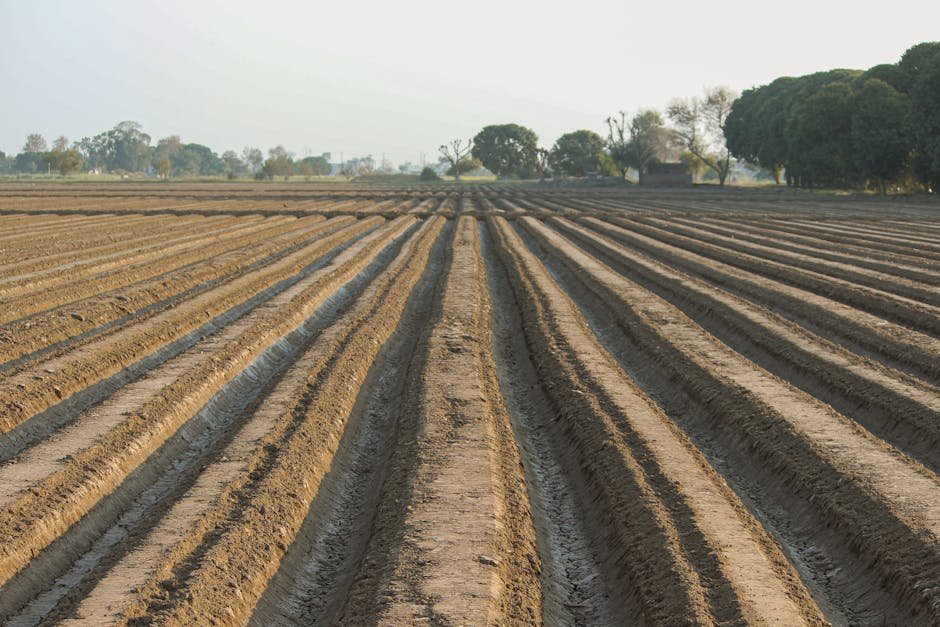
 Photo: Zaryab Haider · Pexels License · source ↗
Broad bed and furrow (BBF) system
Broad bed and furrow (BBF) is a soil-and-water management land-configuration technique developed at ICRISAT, Patancheru in the 1970s for cracking-clay (vertisol) soils of semi-arid India. It alternates broad, slightly elevated beds (where the crop sits) with narrow shallow furrows (which collect, drain and store rain water), reducing both waterlogging in wet weeks and moisture loss in dry weeks within the same kharif season.
Principle
Vertisols swell and crack, and in monsoon spells they alternately waterlog and dry. BBF works on three mechanisms simultaneously. The raised bed drains laterally so the root zone does not stay anaerobic. The furrows act as in-field water-harvesting micro-channels, holding ponded water that infiltrates slowly and recharges the bed during dry spells. The 0.4-0.6% grade in the furrows discharges excess water safely to a grassed waterway, preventing the gully erosion that flat sowing produces in heavy rains.
Procedure
ICRISAT and ICAR-CRIDA recommend a standard layout of 150 cm bed + 45 cm furrow, giving a 195 cm wheel-track repeat that suits both bullock-drawn and tractor-drawn equipment. Two-bottom country plough or a bed-shaper is used to form beds across the slope. Two to four rows of crop are sown along the bed top — for example, two rows of redgram at 75 cm, three rows of groundnut at 30 cm, or sorghum-pigeonpea (2:1) intercrop. A tropicultor or wheel-hoe is run through the furrow for inter-cultivation. Beds are re-shaped every season as part of summer ploughing.
Where it applies
BBF is the recommended land treatment for vertisols and deep black soils in: - Western India: Maharashtra (Marathwada, Vidarbha), Madhya Pradesh (Malwa, Bundelkhand) and Gujarat - South India: parts of Karnataka (north), Telangana and northern Andhra Pradesh - Crops: rainfed redgram, soybean, sorghum, groundnut on heavy soils, cotton, gram and the kharif-rabi double-cropping systems that vertisols support after BBF treatment
ICRISAT trials documented 25-45% pod-and-grain yield gains in groundnut and redgram on BBF compared with flat sowing in normal-rainfall years.
Limitations
BBF needs a bed-shaper that small farmers do not own; custom-hiring centres and SMAM-funded farm-machinery banks (SMAM scheme) usually supply the implement. The technique works poorly on shallow red sandy loams (chalka soils of Anantapur/Rayalaseema), where lateral drainage is unnecessary and the bed accelerates moisture loss; for those soils dead furrows and tied ridges are preferred. Re-shaping each year adds a tillage operation that some farmers skip.
Related pages
See also: Raised-bed groundnut, Dead furrows dryland, Mulching with organic residue, SMAM machinery scheme.
Sources
- Broad bed and furrow landform. ICRISAT, Patancheru.
- In-situ moisture conservation for rainfed groundnut. ICAR-CRIDA.
- Improved land configuration: BBF. ICAR-IIPR, Kanpur.