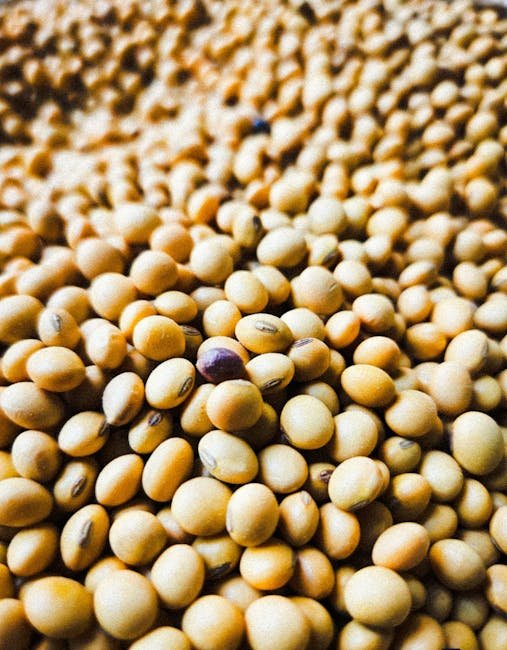
 Photo: placeholder pending image-fill pass
Soybean MSP procurement in Madhya Pradesh
Soybean is one of the 23 crops with an annual Minimum Support Price (MSP) recommended by CACP and notified before the kharif season. Madhya Pradesh, which accounts for 45-50 percent of national soybean production, is the principal state where MSP-based procurement of soybean is operated under the central Price Support Scheme (PSS) when the prevailing market price falls below MSP. The state has also experimented with the alternative Bhavantar Bhugtan Yojana (price-deficiency payment) for soybean in 2017-18.
MSP and the procurement trigger
CACP recommends soybean MSP each year ahead of the kharif sowing window. The MSP for soybean (yellow) was ₹3,950/qtl for 2022-23, ₹4,300/qtl for 2023-24, ₹4,892/qtl for 2024-25 kharif (rabi marketing season 2025), and ₹5,328/qtl for 2025-26. PSS is activated when the modal mandi price in the state falls below MSP. The Department of Agriculture & Cooperation (DA&FW) notifies a procurement target for the state, and the central nodal agency NAFED — through Madhya Pradesh State Cooperative Marketing Federation (MARKFED) as the implementing partner — opens procurement centres in major mandis.
Eligibility and registration
Only farmers registered on the MP Kisan portal with verified Aadhaar-linked bank accounts, land records (girdawari) and proof of soybean sowing in the current season can sell at the MSP centre. Procurement is capped at a per-farmer ceiling tied to land-record area and notified per-hectare productivity (typically 12-15 quintals/ha for soybean). Quality norms — Fair Average Quality (FAQ) — require moisture below 12 percent, foreign matter below 2 percent, damaged grain below 3 percent and immature grain below 5 percent. Soybean below FAQ is procured under "non-FAQ" terms at a discount or rejected.
Procurement operations
NAFED, MARKFED and state cooperative banks operate procurement centres at notified mandi yards. Soybean is weighed, graded, and the procurement bill issued to the farmer; payment is credited to the farmer's bank account within 7-15 days. NAFED stocks the soybean in CWC/SWC warehouses and disposes through open tender to crushers and the trade. In 2024-25 the Cabinet sanctioned procurement of up to 13.68 lakh tonnes of soybean under PSS across Madhya Pradesh, Maharashtra, Karnataka, Telangana and Rajasthan, with Madhya Pradesh getting the largest share.
Bhavantar Bhugtan Yojana (price-deficiency payment)
In 2017-18 MP launched the Bhavantar Bhugtan Yojana for eight crops including soybean. Instead of physical procurement, the state paid the difference between MSP and the modal market price for a notified reference period directly to the farmer's bank account. The scheme was criticised for triggering mandi price suppression and was discontinued for soybean after 2019. The 2024-25 PM-AASHA umbrella scheme has revived a similar Price Deficiency Payment (PDP) component as an alternative to PSS, with farmers free to opt for either.
Limitations
PSS procurement of soybean has historically been limited by warehouse capacity, the short procurement window (October-December), delayed payment when the modal price oscillates above and below MSP, and quality-rejection at FAQ inspection. The new PM-AASHA framework with PDP, PSS and PDPS as menu options is designed to broaden coverage, but actual procurement has typically reached only 15-30 percent of marketed surplus even in MP.
Related pages
See also: Soybean JS-335, NMOOP, MSP, CACP, Price Support Scheme.
Sources
- Price Support Scheme. Department of Agriculture & Farmers Welfare.
- MSP and PSS Operations. National Agricultural Cooperative Marketing Federation (NAFED).
- Bhavantar Bhugtan Yojana. Madhya Pradesh Government.