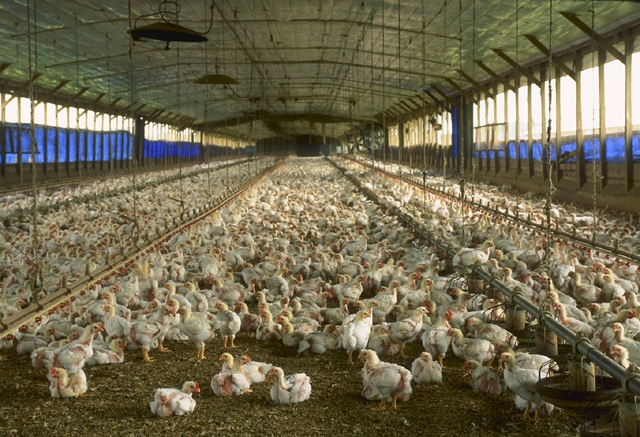
 Photo: Larry Rana · Public domain · source ↗

Poultry mortality management
Mortality management is the set of housing, brooding, vaccination, biosecurity and nutrition practices that keep flock losses inside accepted commercial benchmarks. It is the second pillar of broiler grow-out economics alongside feed conversion ratio (Feed Conversion Ratio), and the principal point of failure in country-chicken and backyard systems.
Benchmarks by bird class
Commercial broilers (Broiler Chicken) target cumulative mortality of 3-5% over a 35-42 day cycle. Commercial layers (Layer Chicken Bv 380) absorb up to about 5% mortality across the long production cycle from point-of-lay to spent-hen sale. Country chicken (Country Chicken Nattu Kodi) under free-range conditions often loses 10% or more, with much higher chick losses to predation, exposure and disease before five weeks of age. ICAR-Directorate of Poultry Research and breeder companies (Aviagen, Cobb) publish week-wise mortality curves that are used both as performance benchmarks and as inputs into the production-coefficient (PC) formula in contract-broiler agreements (Contract Broiler Farming).
Principal causes
The first week dominates total cycle mortality. Brooding-temperature mismanagement (Brooding Chicks) — cold floors, dehydration, ammonia-laden litter — kills weak chicks before feed intake establishes. From week two onward, three driver categories take over.
Infectious disease. Ranikhet (Newcastle) disease (Ranikhet Newcastle Disease), infectious bursal disease (Gumboro) and infectious bronchitis are the major viral killers; coccidiosis and E. coli the major enteric ones; mycoplasma the leading chronic respiratory cause. Routine vaccination and antibody monitoring control most of these.
Environmental and nutritional stress. Ammonia build-up under poor ventilation (Shed Height Ventilation), wet caked litter (Deep Litter System), heat stress in summer, cold draughts in winter, and feed contamination with aflatoxins or biogenic amines all raise both clinical mortality and silent culls.
Water quality. Hard, alkaline or microbially contaminated water depresses intake, causes wet droppings and predisposes to enteric mortality (Water Hardness Poultry).
Implementation
Mortality management is a sum of small disciplines: pre-warming the litter to the chick's body temperature on placement day; lighting and watering protocols for the first 72 hours; matched vaccination at correct ages by spray, eye-drop or drinking-water route; weekly serological monitoring in larger flocks; chlorination or descaling of water lines; clean inter-batch sanitation (Biosecurity Cleaning Between Batches); and daily walk-throughs to remove sick birds.
Related entries
See also: Open Poultry Shed, Contract Broiler Farming.
References
- Data Analytics of Broiler Growth Dynamics and FCR. PMC.