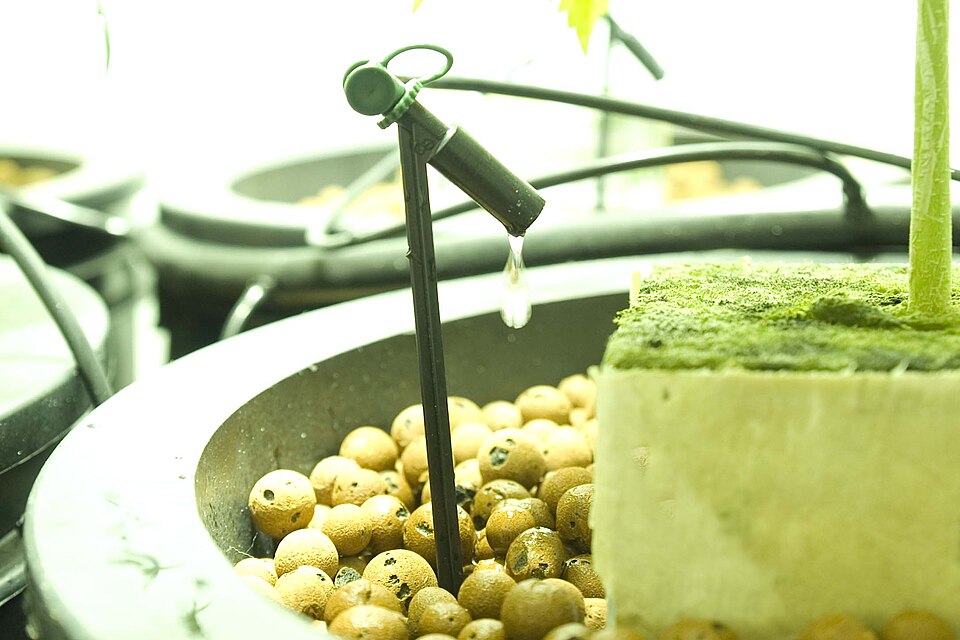
 Photo: Alan.ca · Public domain · source ↗

Drip irrigation
Drip irrigation is a low-pressure micro-irrigation method that delivers water, and optionally dissolved fertilisers, directly to each plant's root zone through emitter-fitted lateral lines. By wetting only a fraction of the field surface and matching delivery to evapotranspiration, drip systems reduce both deep-percolation and evaporation losses relative to flood or furrow irrigation.
Principle
A pump or gravity head pressurises filtered water through a network of mains and sub-mains into thin-walled lateral tubes laid along crop rows. Inline or online emitters discharge water at low rates, typically 1-8 litres per hour, creating a wetted bulb around the root system. Compatible fertilisers can be injected upstream of the laterals, an extension of the method known as Fertigation.
Implementation
Standard components include a sand or screen filter, pressure-regulating valves, PVC mains, polyethylene laterals and emitters. Under PMKSY's Per Drop More Crop (PDMC) component, only BIS-certified components are eligible for subsidy. PDMC assistance covers 55% of cost for small and marginal farmers and 45% for other farmers, capped at 5 hectares per beneficiary. Layout is matched to crop spacing: paired-row laterals for wider crops such as orchard trees, single-line laterals for vegetables and pulses.
Adoption context
PDMC reports water savings of up to 40% and productivity gains of around 25% over conventionally irrigated plots. In Indian conditions, drip is widely used on chilli, vegetables, oil palm and orchard crops, where it pairs with fertigation to lower nutrient input. It is also used for wide-spaced rainfed crops such as cotton during dry spells. Related sprinkler and rain-gun systems share the PDMC subsidy framework; see Sprinkler Irrigation and Rain Gun Irrigation.
Limitations
Emitters are vulnerable to physical, chemical and biological clogging; see Drip Emitter Clogging for the standard filtration, flushing and acid/chlorine treatment regime. Initial capital cost per hectare is high relative to surface irrigation, and rodent or implement damage to laterals requires periodic replacement. Energy is required for pressurisation unless a sufficient elevation head is available.
Related entries
See also: Sprinkler Irrigation, Fertigation, Automatic Drip Irrigation, Rain Gun Irrigation, Drip Emitter Clogging, Paddy Water Management.
References
- Operational Guidelines of Per Drop More Crop. Pradhan Mantri Krishi Sinchayee Yojana.
- PMKSY-PDMC scheme page. myScheme portal, Government of India.
- PMKSY factsheet. Press Information Bureau, 2022.