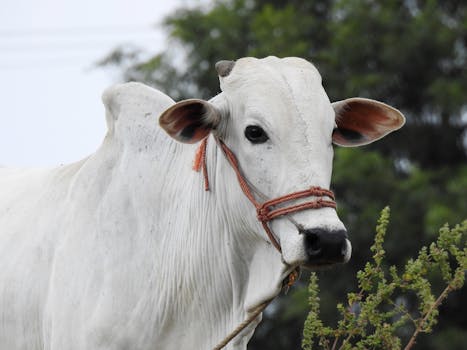
 Photo: Sharath G. · Pexels License · source ↗
Native (desi) cow in natural farming
In Indian natural-farming systems, the indigenous (desi) cow occupies a role distinct from its place in commercial dairying: it is treated primarily as a producer of biological inputs that condition the soil rather than as a milk-producing economic unit. Indigenous breeds are Bos indicus zebus, recognised by the prominent shoulder hump, dewlap and heat tolerance, and include Sahiwal (Sahiwal Cow), Gir, Tharparkar, Red Sindhi, Ongole (Ongole Cattle) and Punganur (Punganur Cow).
Role in natural farming
Natural-farming protocols popularised through state programmes such as Andhra Pradesh Community Managed Natural Farming and Subhash Palekar Natural Farming use desi-cow dung and urine as the base ingredient of jeevamrutham (also spelled jeevamruth), a fermented inoculum applied to soil. A 200-litre batch typically combines 10 kg of fresh desi-cow dung, 5-10 litres of cow urine, 1-2 kg of jaggery, 1-2 kg of pulse flour and a handful of uncontaminated soil from a healthy field. After 48-72 hours of aerobic fermentation, the suspension is filtered and applied with irrigation water at roughly 200 litres per acre. Practitioners hold that one desi cow can supply the inputs for around 12 acres of natural-farming cropping.
Why indigenous breeds specifically
Government extension literature and natural-farming texts emphasise indigenous breeds for three reasons: cultural and ritual familiarity, the perceived microbial profile of their dung, and the A2 beta-casein profile of their milk that has driven a separate premium retail segment. The technical claim of microbial superiority over crossbred-cow dung is debated in academic literature, but the practice is institutionally anchored.
Policy and conservation context
The Department of Animal Husbandry and Dairying launched the Rashtriya Gokul Mission in December 2014, dedicated to conservation and genetic upgradation of indigenous breeds. The scheme supports breeding farms, sex-sorted semen production, and on-farm artificial insemination (Artificial Insemination Cattle) using indigenous bulls, with the aim of raising both numbers and per-animal productivity of desi cattle alongside their natural-farming role. This is a deliberate counterweight to four decades of crossbreeding with HF (Holstein Friesian Crossbred Cow) and Jersey (Jersey Crossbred Cow) that lifted national milk volumes but reduced the indigenous gene pool.
Limitations
Per-cow milk yield of indigenous breeds is markedly lower than that of crossbreds, which reduces income from milk procurement based on fat and SNF (Milk Fat Snf Pricing). Natural-farming economics therefore depend on premium pricing for A2 milk, value addition through ghee and curd, and the unaccounted soil-health benefit of in-field jeevamrutham application.
Related entries
See also: Dairy Shed Design.
References
- Rashtriya Gokul Mission. Department of Animal Husbandry and Dairying.
- Cow-based natural farming practice — case study from Andhra Pradesh. ResearchGate.