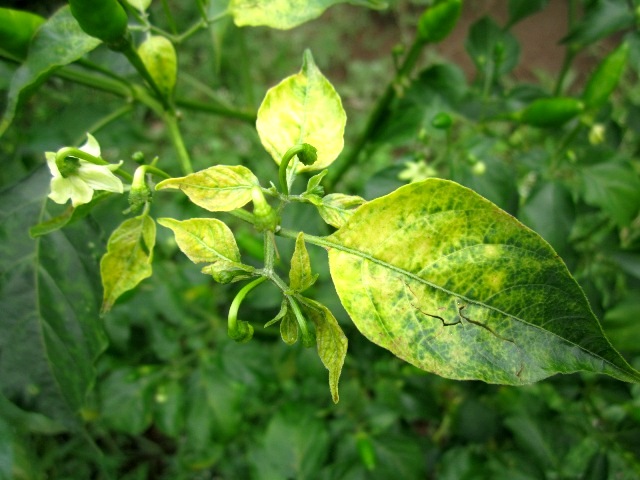
 Photo: Kembangraps · CC0 · source ↗

Chilli leaf curl virus complex (begomovirus)
Chilli leaf curl is caused by a complex of begomoviruses (family Geminiviridae) transmitted persistently by the whitefly Bemisia tabaci. This entry covers the breeding and host-resistance dimension of the disease; clinical symptoms and integrated management are described under the parallel pathology entry (Disease Chilli Leaf Curl Virus).
Identification and symptoms
Infected plants show upward leaf curl, vein clearing, leaf-blade reduction and stunting. Heavy early infection can suppress flowering and pod-set.
Host crops / Life cycle
The disease is transmitted by Bemisia tabaci (Pest Sucking Pests Chilli) in a persistent-circulative manner. The pathogen complex includes several distinct begomoviruses recovered from Indian chilli germplasm.
Damage and economic impact
ICAR-IIHR Bengaluru anchors the Indian public-sector breeding pipeline for resistance. Released tolerant cultivars include Arka Yashasvi (H 8) and Arka Tejasvi; the latter has a stated yield potential of 30-35 quintals per acre of dry chilli. ICAR-IIVR Varanasi maintains begomovirus screening protocols for chilli germplasm.
Management (cultural, biological, chemical)
Field management combines whitefly suppression — insect-proof nets (Practice Chilli Nursery Raising), reflective mulch, and imidacloprid/diafenthiuron rotations (Practice Chilli Spray Schedule) — with rogueing of infected plants and use of tolerant hybrids such as the ICAR-IIHR Arka series and BASF Armour (Chilli Basf Armour).
Related entries
Disease Chilli Leaf Curl Virus, Pest Sucking Pests Chilli, Chilli Basf Armour, Practice Chilli Spray Schedule
References
- Chilli varieties. ICAR-IIHR.
- Breeding strategies for chilli leaf curl virus management. Frontiers in Plant Science, 2023.