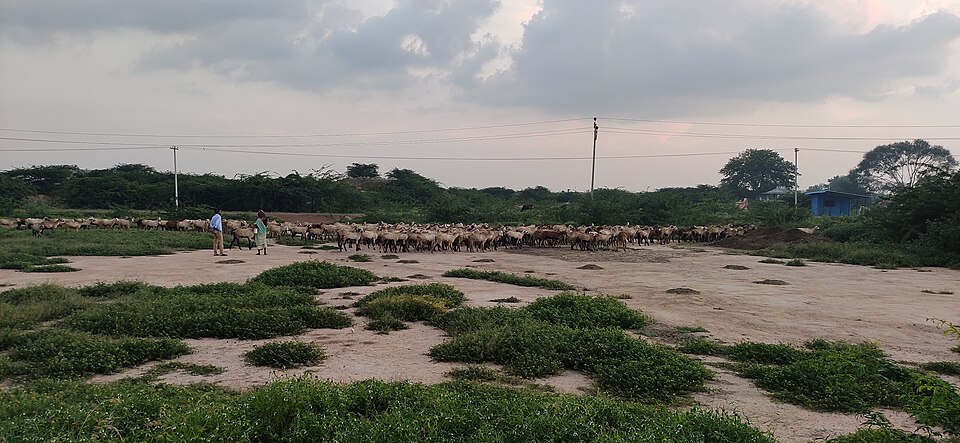
 Photo: வெங்கட்ராமன். தி · CC BY-SA 4.0 · source ↗

Nellore sheep
Nellore is the premier meat-type sheep breed of Andhra Pradesh, registered with the ICAR National Bureau of Animal Genetic Resources (NBAGR). It is the tallest of the Indian sheep breeds and is closely associated with the meat-mutton economy of the south-east Deccan. The breed exists as three geographically isolated strains: Jodipi, Palla and Brown.
Origin and distribution
The breeding tract centres on Nellore and Prakasam districts of Andhra Pradesh, extending into adjoining tracts of Telangana and Karnataka. Nellore sheep are kept in semi-arid, scarce-rainfall zones with mixed crop-livestock production and long migratory routes.
Morphology
Nellore animals are tall and rangy, more goat-like in conformation than the woolly hill breeds. The hair coat is sparse over most of the body, with denser hair retained at the brisket and breech. Ears are long and pendulous, around 15 cm. Rams are typically horned with stout, curving horns; ewes are largely polled. Coat colour distinguishes the three strains — the Jodipi has black-and-white markings, the Palla is solid white, and the Brown strain is light brown to fawn. The tail is short and thin. Adult body weight averages 36 kg in males and 28 kg in females.
Performance
Reproduction is single-lambed; multiple births are uncommon. Age at first lambing is around 28 months and the lambing interval averages 14 months — a slow reproductive cycle compared with prolific small-ruminant breeds such as Black Bengal goat (Black Bengal Goat). The breed compensates with rapid post-weaning growth and large mature carcass size, which suits the festival ram-lamb market.
Management
Nellore sheep are reared under three overlapping systems: traditional transhumant grazing by the Kuruma and Golla communities of Andhra Pradesh and Telangana (Migratory Sheep Grazing), stationary mixed crop-livestock village herds, and increasingly semi-intensive feedlot fattening of ram lambs for the Bakrid market (Ram Fattening Bakrid). Elevated slatted-floor sheds (Elevated Goat Sheep Shed) are used by commercial breeders to keep stationary flocks healthy. Structured small-ruminant vaccination (Small Ruminant Vaccination Schedule) and seasonal bluetongue (Bluetongue Sheep) management are essential to control losses.
Related entries
See also: Osmanabadi Goat.
References
- Sheep Breeds of India. ICAR-National Bureau of Animal Genetic Resources.
- Nellore Sheep. South Asia Pro-Poor Livestock Policy Programme.