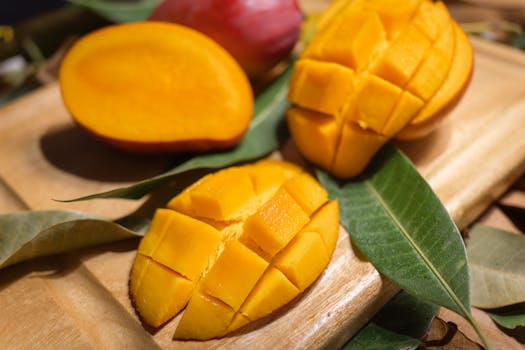
 Photo: Wil Carranza · Pexels License · source ↗
Mango value-addition (rolls, thandra, orugulu)
Mango fruit-leather is one of the oldest and most widespread value-added products from Indian mangoes. It is known by various regional names: aam papad in north India, mamidi thandra in Telugu, aamsotto in Bengali and ambavadi in Marathi. CSIR-CFTRI Mysore has documented industrial-scale specifications for this and other mango processing technologies.
Principle
Mango fruit-leather is produced by concentrating mango pulp with sugar, then drying it in thin layers to form a chewy sheet with very low water activity. The product preserves the seasonal mango pulp for year-round consumption and is stable at ambient temperature.
Implementation
A typical process is:
- Ripe mangoes are washed, peeled and depulped, often using mechanical pulpers.
- Pulp is mixed with sugar at around 30-40% by weight, optionally with citric acid for tartness; potassium metabisulphite (KMS) may be added at low ppm levels as a preservative.
- The blended pulp is spread in thin layers on greased trays or stainless-steel sheets.
- Each layer is sun-dried (or oven-dried at 50-60 deg C) until tacky, then another layer is poured on top.
- The process is repeated until the desired thickness (typically 8-15 mm) is reached.
- The cured sheet is rolled, cut into pieces or strips, and packaged.
CFTRI documentation reports that processed mango juice in selected cultivars contains around 18-20% TSS with 5-18% reducing sugars, providing the natural sugar base for the product.
Adoption context
Mango fruit-leather is produced both as a cottage industry and in organised processing units in Andhra Pradesh, Karnataka, Maharashtra, Gujarat, West Bengal and Uttar Pradesh, drawing on regional cultivars including Banganapalli (Mango Banganapalli Beneshan), Alphonso (Mango Alphonso), Kesar (Mango Kesar), Dasheri (Mango Dasheri), Himayat (Mango Himayat Himam Pasand) and the pulp-grade Totapuri (Mango Totapuri).
Limitations
Sun-drying is sensitive to weather and dust; mechanical dryers improve consistency but raise capital cost. Sulphite preservation is regulated, and consumer-facing brands increasingly favour KMS-free, low-sugar formulations.
Related entries
See also: Mango Orchard Establishment Hdp, Mango Canopy Training Pruning, Mango Flowering Management, Fruit Fly Orchard Pest.
References
- Mango processing technologies. CSIR-CFTRI Mysore.
- Aam papad. Wikipedia.