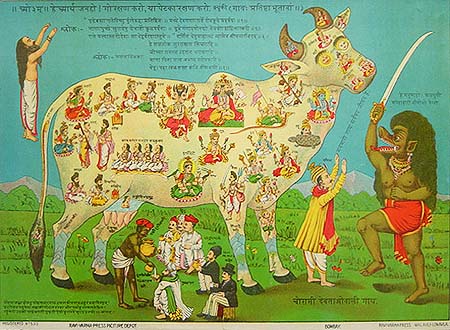
 Photo: Fritz Schleicher lithographic transfer of Raja Ravi Varma original. · Public domain · source ↗

Panchagavya
Panchagavya is a fermented foliar growth promoter prepared from five cow products (dung, urine, milk, curd, ghee) together with jaggery, banana, tender coconut water and water. Standardised by Dr K Natarajan and TNAU, it is one of the principal traditional liquid biostimulants used in organic and natural-farming systems in India.
Composition
- Five cow products: cow dung, cow urine, cow milk, curd and ghee
- Auxiliary ingredients: jaggery, banana, tender coconut water and water
- Optional additions in extended recipes: ash gourd, dates, sugarcane juice
- Container: 200 L plastic or earthen drums
Chemical analyses of the matured product report approximately 229 ppm N, 209 ppm P and 232 ppm K, alongside high lactobacillus, yeast and beneficial bacterial loads.
Preparation
The five cow products are combined first and fermented for the first week. Auxiliary ingredients (jaggery, banana, tender coconut water and optional additions) are added in the second week. The mixture is stirred clockwise twice daily throughout. Fermentation completes in 21 days, yielding a brown-amber liquid with a characteristic sweet-fermented odour. Shelf life of the cured product is approximately six months, with fresh batches typically started every 15-20 days for active spray programmes.
Mode of action
Panchagavya combines a low-density NPK supply with a high-density microbial culture and naturally occurring phytohormones (auxins, cytokinins, gibberellins from coconut water and banana). The cow-product fermentation produces lactic acid bacteria, yeasts, photosynthetic bacteria and beneficial fungi that establish on the leaf surface and in the rhizosphere when sprayed. Foliar effects include improvements in leaf area, chlorophyll content and stress tolerance.
Target use and dose
- Foliar spray: 3% solution (3 L per 100 L of water; in extension practice often given as 1 L per 20 L water per acre). In rice, two sprays are typical, at active tillering (around 25 DAT) and at panicle initiation (around 45 DAT).
- Soil drench/irrigation: approximately 10 L per acre through irrigation water.
- Seed/seedling treatment: 3% solution.
Used across rice, vegetables, pulses, oilseeds and orchards in organic and natural-farming systems.
Safety and regulatory status
Non-toxic and approved within FCO biostimulant and organic-input frameworks; widely used in certified-organic and natural-farming production.
Related entries
See also: Jeevamrutham Drava, Ghana Jeevamrutham, Jeevamrutham Orchard Input, Vermiwash, Microbial Biofertilizers, Neem Oil.
References
- Panchakavya. TNAU Agritech Portal.
- Panchagavya. Vikaspedia agriculture portal.