 Photo: placeholder pending image-fill pass
Orthodox vs CTC tea processing
Orthodox and CTC (Crush-Tear-Curl) are the two dominant manufacturing routes for Indian black tea. Both start from the same green leaf — two leaves and a bud — but use different machinery during the rolling stage and produce visually and organoleptically distinct made teas. India's annual production of roughly 1,300-1,400 million kg is approximately 85% CTC and 15% orthodox, with green tea and specialty teas making up a small residual.
Common preliminary steps
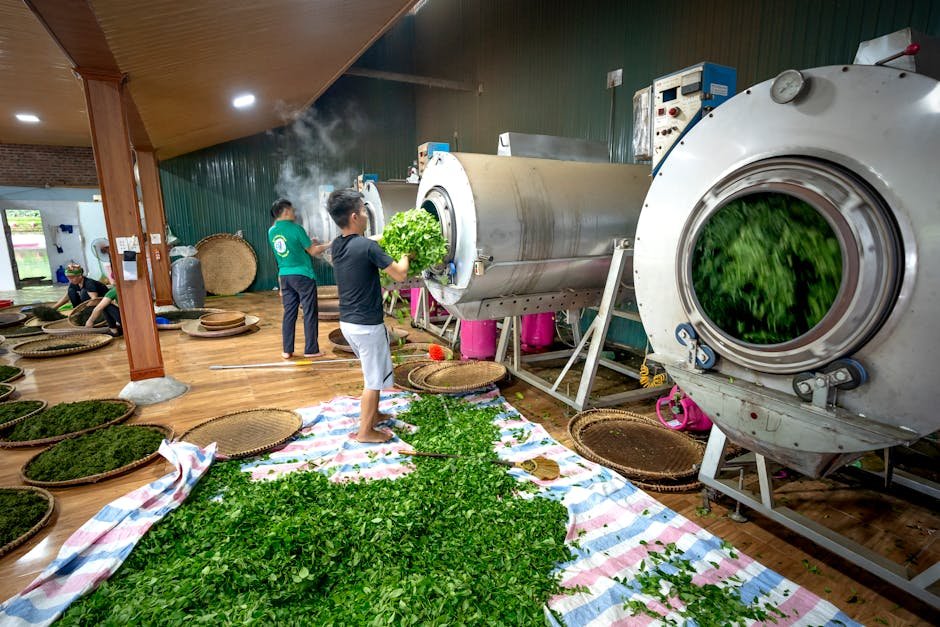
In both routes, freshly plucked leaf is spread on long withering troughs and dehydrated for 14-20 hours by forced ambient or warm air until moisture drops from ~78% to 60-66%. This makes the leaf pliable and develops aroma precursors. Withered leaf is then sent to the rolling/maceration department, which is where the two methods diverge.
Orthodox route
The withered leaf passes through a 36" or 46" orthodox roller, where curved battens twist and lightly crush whole leaves for 30-45 minutes. The "first dhool" of finer leaf is sieved off and laid out to oxidise; the larger leaf is re-rolled. Oxidation (fermentation) is carried out on aluminium trays or beds at 24-27 °C and 90-95% RH for 1.5-3 hours. The colour shifts from green to coppery brown. Firing in a fluid-bed or endless-chain drier at 95-110 °C arrests the enzymes and brings moisture to ~3%.
Orthodox grades retain leaf integrity and aroma: SFTGFOP (Super Fine Tippy Golden Flowery Orange Pekoe), FTGFOP, TGFOP, OP, BOP and the broken/fanning grades. This is the route used for Tea Darjeeling First Flush Gi, Tea Assam Orthodox Second Flush Gi, Nilgiri whole-leaf and Kangra orthodox.
CTC route
Withered leaf is first lightly broken on a rotorvane, then fed through three or four pairs of close-set, helically-grooved stainless-steel rollers turning at differential speeds. These rollers crush, tear and curl the cell mass into hard granular particles in under 60 seconds. Oxidation is much faster (45-90 minutes) because of the high cell rupture, and firing follows on the same fluid-bed driers used in orthodox.
CTC grades — BP (Broken Pekoe), BOP, BOPF, PF, PD, Dust 1 — are small, hard, fast-brewing granules that give a strong, coloury, brisk liquor ideal for milk and masala blends. Detailed mechanics are covered in Tea Ctc Cut Tear Curl Process.
Why both routes survive
CTC dominates the domestic Indian market because of high cup-per-kg yield (~400 cups/kg vs ~250-300 for orthodox) and suitability for milk-tea. Orthodox commands a price premium of 40-100% on export markets in the Middle East, CIS, Iran, Germany and Japan. Many gardens — especially in Assam and Nilgiris — operate both lines and switch by season and by clone, sending high-elevation, slow-grown flushes to the orthodox line and plains second-flush leaf to CTC.
Related entries
See also: Tea Ctc Cut Tear Curl Process, Tea Camellia Sinensis Assamica, Tea Camellia Sinensis China Type, Tea Darjeeling First Flush Gi, Tea Assam Orthodox Second Flush Gi, Tea Auction System India Kolkata.
References
- Tea Research Association Tocklai — Manufacture. https://www.tocklai.org/
- Tea Board India — Manufacturing Statistics. https://www.teaboard.gov.in/