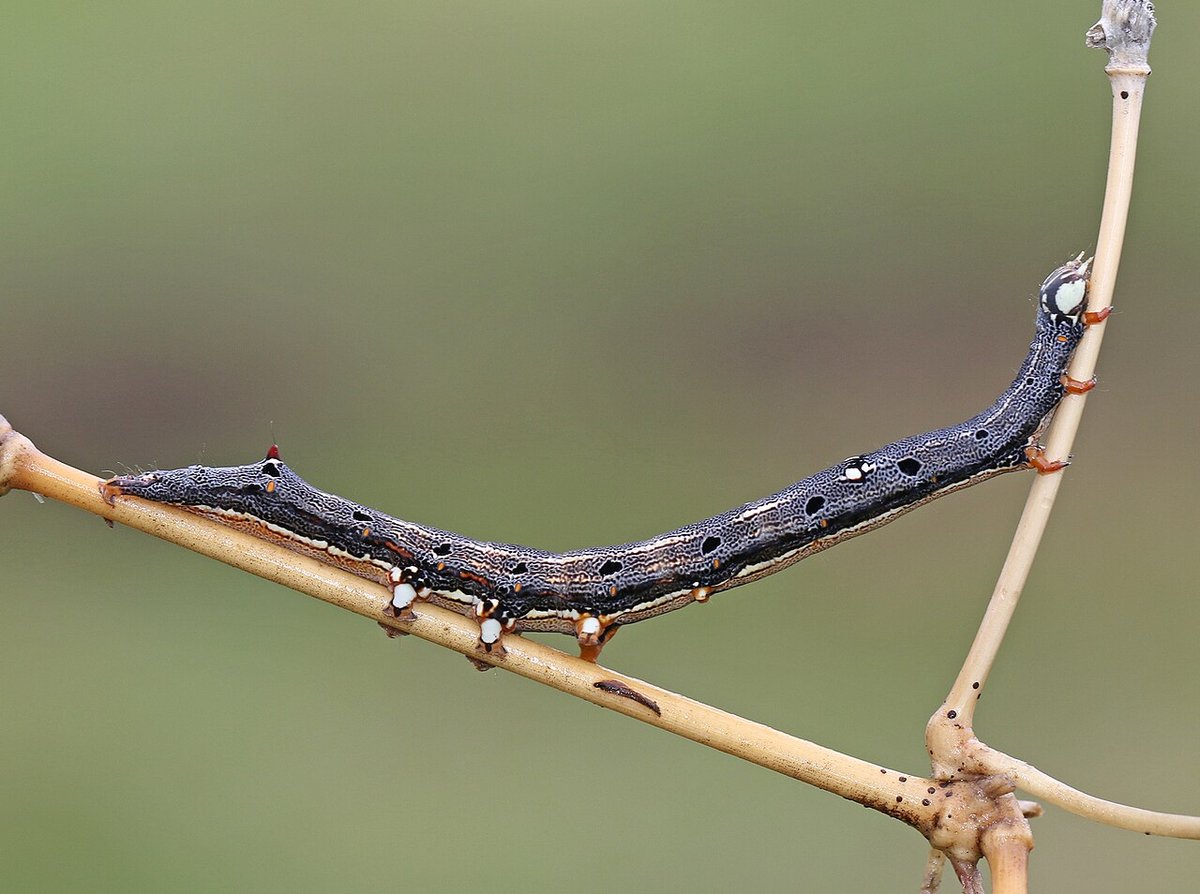
 Photo: Milind Bhakare · CC BY-SA 4.0 · source ↗

Castor semilooper (Achaea janata)
The castor semilooper Achaea janata L. (Lepidoptera: Erebidae) is the principal defoliator of castor (Ricinus communis) in semi-arid India. Severe outbreaks can completely strip foliage during the vegetative and primary-spike stages and reduce capsule yield by 30-50%. In the rainfed castor belt of Rayalaseema, southern Telangana and northern Karnataka, semilooper is the number-one in-season insect pest tracked by the ICAR-IIOR pest-surveillance network.
Identification and biology
- Moth: medium-sized (wingspan 60-70 mm), forewings grey-brown with darker striations; hindwings black with a broad white band — the diagnostic field character.
- Egg: pale green, hemispherical, laid singly or in small clusters on underside of leaves.
- Larva: characteristic semilooping gait (only 3 pairs of prolegs functional); newly hatched larvae green, later instars brown-black with red head, yellow lateral lines and red spots. Full-grown larva 55-65 mm.
- Pupa: dark brown, inside a loose silken cocoon in soil or among leaves.
- Lifecycle: 25-35 days egg-to-adult; 4-6 generations a year; population peaks in August-October on kharif castor.
Damage and symptoms
Young larvae skeletonize leaves; later instars are voracious chewers and can defoliate entire plants overnight, leaving only the midribs and petioles. Heavy attack at the primary-spike stage delays spike emergence and reduces seed set; defoliation during capsule fill drops oil content and 100-seed weight.
Hosts and economic impact
Achaea janata is polyphagous but castor is its preferred host; it also attacks pomegranate, rose, citrus and several legumes. On castor it causes 30-50% yield loss in unmanaged outbreaks; routine years see 5-15% loss.
Management
ICAR-IIOR IPM package:
- Scouting: weekly counts during August-November. ETL = 4 larvae per plant or 25% defoliation.
- Mechanical: hand-pick and destroy gregarious early-instar larvae (they cluster on lower leaves).
- Cultural: deep summer ploughing to expose pupae; remove castor stubble; avoid continuous castor monocropping.
- Biocontrol: NPV (AjNPV) @ 250 LE/ha; Trichogramma chilonis @ 50,000/ha at egg stage; conserve natural enemies (Microplitis maculipennis parasitoids and reduviid bugs).
- Botanical: 5% NSKE (Neem Seed Kernel Extract) effective on early instars.
- Chemical: at ETL apply chlorantraniliprole 18.5 SC @ 0.3 ml/L, flubendiamide 39.35 SC @ 0.2 ml/L, emamectin benzoate 5 SG @ 0.4 g/L, or quinalphos 25 EC @ 2 ml/L. Rotate modes of action.
Related pages
See also: Castor Crop, Castor Hybrid GCH-7, Spodoptera Tobacco Caterpillar, Fall Armyworm Maize.
Sources
- Castor pests and IPM - ICAR-IIOR Hyderabad. ICAR-IIOR.
- Castor - TNAU Agritech. TNAU.