 Photo: NASA · Public domain · source ↗

Rice stubble burning (Punjab and Haryana)
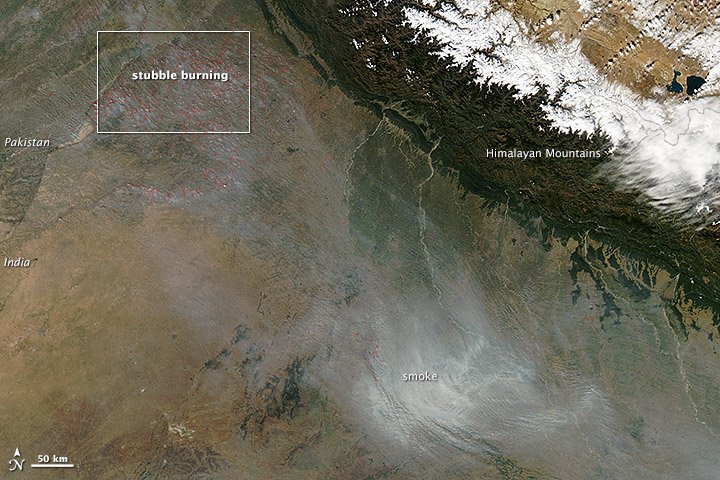
Rice stubble burning is the open-field burning of paddy crop residue in October and November after combine harvest, predominantly in Punjab, Haryana, western Uttar Pradesh and parts of Delhi NCR. The practice generates roughly 70-150 lakh tonnes of straw burnt every kharif and is the single largest seasonal contributor to the Delhi-NCR winter PM2.5 air-quality crisis between mid-October and mid-November.
Why it happens
The rice-wheat rotation leaves a narrow 7-15 day window between paddy harvest (mid-October) and wheat sowing (early November). Combine harvesters cut paddy at 30-40 cm, leaving 6-9 t/ha of standing straw that is lignified, low in nitrogen and slow to decompose under cool, dry post-monsoon conditions. Manually removing or incorporating straw costs Rs 4,000-7,000 per acre in labour and machinery, with no ready market for rice straw because of its high silica content. Burning costs nothing and clears the field in under an hour, so it remains the dominant disposal route despite legal prohibition under the Air Act and the Commission for Air Quality Management (CAQM) directions.
Air-quality impact
Satellite data from ISRO and the Indian Council of Agricultural Research-Air Quality Indicator system records 50,000-100,000 stubble fire events per kharif across Punjab and Haryana. Fire-emission inventories estimate seasonal emissions of 200-300 Gg of PM2.5, 1,500-2,500 Gg of CO and 100-200 Gg of CH4. Burning contributes 25-40% of Delhi's October-November PM2.5 on peak fire days under typical north-westerly winds.
Management
Government action has combined four lines of intervention: (i) subsidised supply of Pusa Decomposer (Rice Pusa Decomposer) and NCOF Waste Decomposer (Rice Bio Decomposer Paddy Residue) for in-situ decomposition; (ii) custom-hiring centres providing Happy Seeder, super seeder, mulcher and SMS-fitted combines; (iii) shorter-duration cultivars such as PR 126 and Pusa Basmati 1509 that vacate fields earlier; (iv) ex-situ straw use in biomass power plants, biogas plants and ethanol units. Pilot trials of cattle-feed densification and mushroom cultivation on rice straw remain small in volume. DSR adoption (Rice Dsr Direct Seeded Rice Punjab) further compresses the window by enabling earlier sowing.
Status
Stubble fire counts fell by roughly 35-50% between 2020 and 2023 according to CAQM and ISRO bulletins, with Haryana making more progress than Punjab. Continued reduction depends on machinery availability, time-discipline in the kharif harvest, and a viable market for ex-situ straw.
Related entries
See also Rice Bio Decomposer Paddy Residue, Rice Pusa Decomposer, In Situ Residue Decomposition, Rice Dsr Direct Seeded Rice Punjab, Pusa Basmati 1509.
Sources
- Directions on Crop Residue Management. Commission for Air Quality Management, Government of India.
- Stubble Burning Action Plan. Press Information Bureau, Government of India.