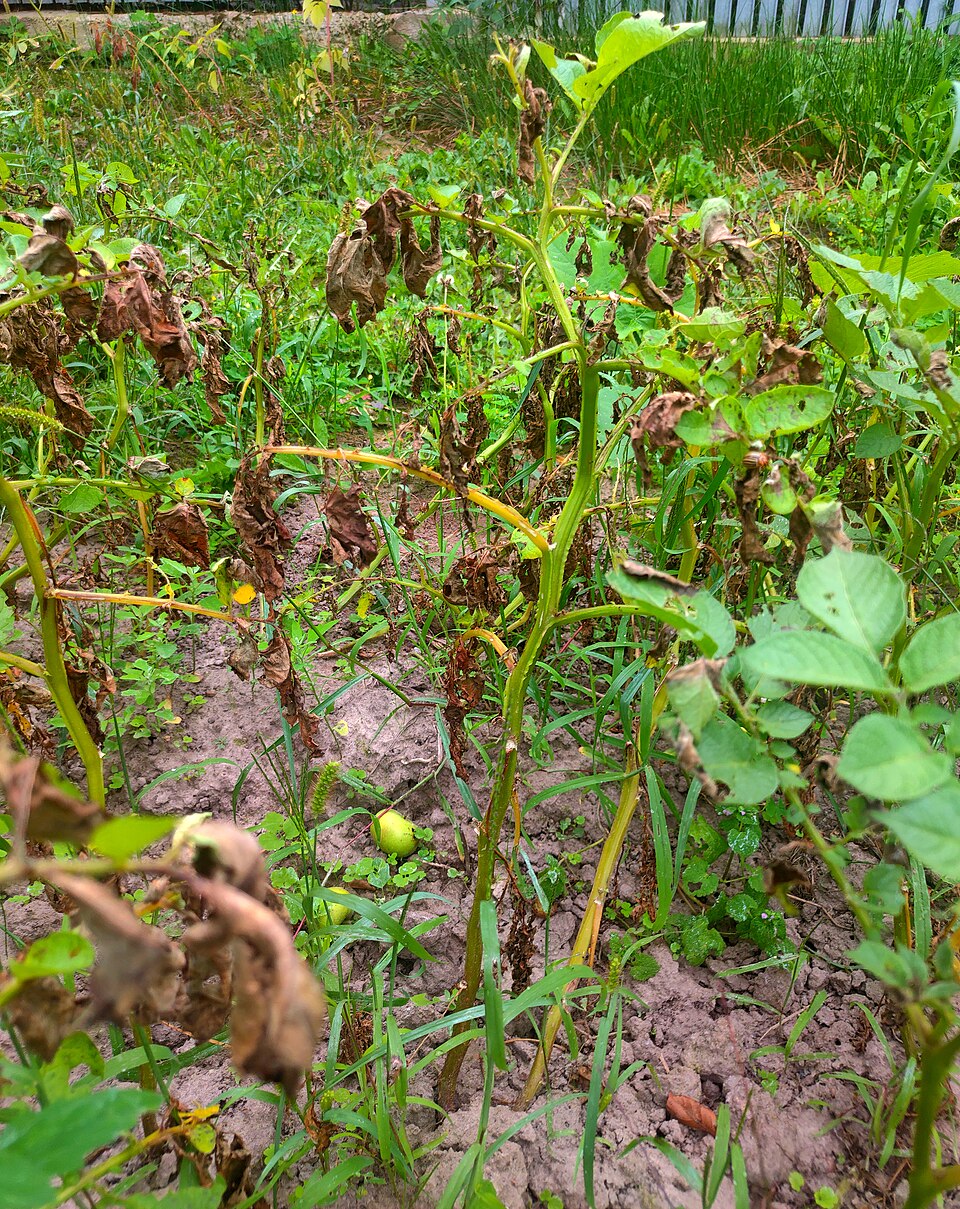
 Photo: Сарапулов · CC BY 4.0 · source ↗

Early and late blight in tomato
Early blight and late blight are two of the most economically important foliar diseases of tomato (Tomato Crop) worldwide. They are caused by different pathogens but are often discussed together in extension practice because both produce destructive leaf, stem and fruit lesions, both are favoured by high humidity, and both are managed using overlapping cultural and fungicide tools.
Identification and symptoms
- Early blight, caused by the fungus Alternaria solani, produces dark brown to black lesions on older leaves with characteristic concentric "target board" rings. Lesions also occur on stems and fruit. The disease typically progresses upward from the lower canopy and is most damaging on stressed or senescing plants.
- Late blight, caused by the oomycete Phytophthora infestans, produces rapidly expanding water-soaked lesions on leaves and stems that quickly turn brown and necrotic, often with a fine white mycelial ring at the lesion margin under humid conditions. Fruit lesions are firm, greasy and dark. Late blight is one of the most destructive tomato diseases globally.
Host crops and life cycle
Both pathogens overwinter on plant debris and survive on solanaceous weeds. They are favoured by extended periods of leaf wetness, high relative humidity and moderate (early blight) to cool (late blight) temperatures, conditions characteristic of the late kharif and early rabi tomato crop in much of India.
Damage and economic impact
Late blight in particular can defoliate a tomato field within days under conducive weather. Yield losses commonly exceed 30-40% in untreated fields when an epidemic establishes.
Management
Standard management combines rotation with non-solanaceous crops, drip irrigation to keep canopies dry instead of overhead sprinklers, removal of infected debris, prophylactic protectant fungicides (mancozeb, chlorothalonil) and systemic fungicides (metalaxyl, cymoxanil) for late blight outbreaks. Biocontrol with Trichoderma viride and Pseudomonas fluorescens is documented in ICAR-supported research.
Related entries
See also: Tomato Crop, Tomato Leaf Curl Virus, Summer Tomato Cultivation.
References
- Impact of late blight (Phytophthora infestans) on tomato yield. Indian Phytopathology.
- Morphological and Molecular Variability of Alternaria solani and Phytophthora infestans. PubMed Central.