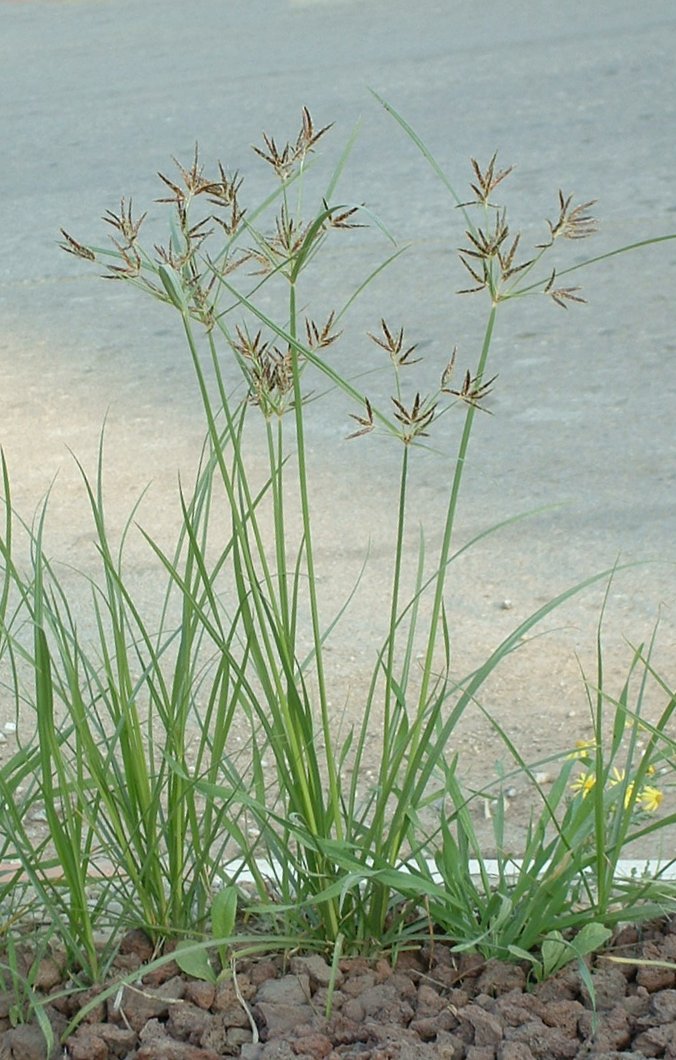
 Photo: No machine-readable author provided. Rickjpelleg assumed (based on copyright cla · CC BY 2.5 · source ↗

Purple nutsedge (Cyperus rotundus / tunga)
Cyperus rotundus, commonly called purple nutsedge and known locally as tunga in Telugu, is a perennial sedge ranked among the world's most troublesome weeds. It is a major problem in chilli, cotton, sugarcane and pulses across India, where its underground tuber chain regenerates faster than most foliar herbicides can suppress.
Identification and symptoms
Purple nutsedge has triangular stems, V-shaped glossy leaves and a characteristic purple-brown inflorescence. The plant is anchored by a network of underground rhizomes that branch into chains of tubers, each capable of producing a new shoot. Field infestations form dense patches that compete strongly with crops for water, nutrients and light, and the tuber bank survives ploughing, drought and most short-residual herbicides.
Biology and host crops
The species is a perennial sedge that propagates mainly through chains of underground tubers rather than seed. Tubers can remain viable in soil for many seasons, sprouting whenever conditions allow. Hosts include nearly all upland cropping systems; the weed is particularly damaging in chilli, cotton, sugarcane and short-duration pulses.
Damage and economic impact
Purple nutsedge can reduce yields significantly in heavily infested fields by depleting soil nutrients and moisture and by physically piercing developing root and tuber crops. The deep tuber bank makes single-season chemical control ineffective; sustained suppression requires multi-year integrated programmes.
Management
The sulfonylurea herbicide halosulfuron-methyl is the most consistently effective chemical option in Indian conditions. At 70 g active ingredient per hectare, applied 20 days after a summer irrigation, ICAR-IIPR Kanpur conservation-agriculture trials report 23-64% reduction in field tuber density. Replicated studies in Weed Science have shown more than 86% reduction in new-tuber production and viability. Because foliar herbicides alone seldom exhaust the deep tuber bank, integration with deep summer ploughing to expose tubers to desiccation and with competitive crop canopies that shade out re-emerging shoots is the recommended approach.
References
- Cover crop and herbicides for Cyperus rotundus. ICAR-Indian Institute of Pulses Research, Industrial Crops and Products.
- Halosulfuron Reduced Purple Nutsedge Tuber Production and Viability. Weed Science.