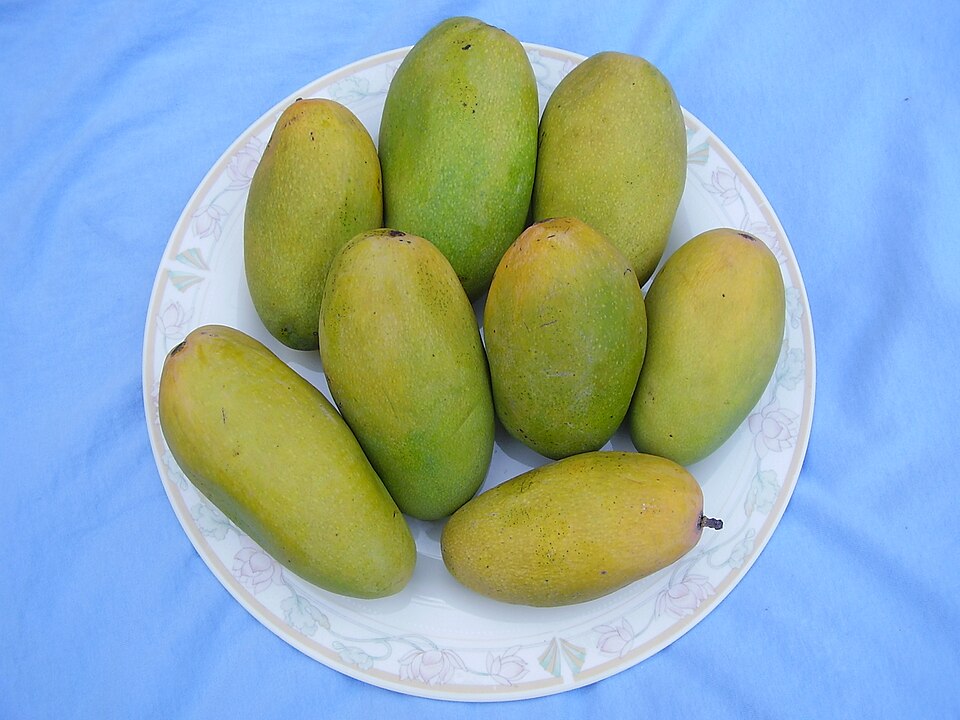
 Photo: Khalid Mahmood · CC BY-SA 3.0 · source ↗

Dasheri mango
Dasheri is a classic north Indian mango cultivar originally selected near Malihabad in Lucknow district, Uttar Pradesh, with origins traced to the 18th century. It is among the foundational cultivars of the Indian mango trade and is one of the principal accessions in the ICAR-CISH Lucknow germplasm collection.
Key characteristics
- Origin: Malihabad, Lucknow district, Uttar Pradesh (18th century)
- Fruit shape: elongated-elliptic, medium size
- Skin: smooth, greenish-yellow at maturity, deepening to gold
- Flesh: fibreless, sweet, fragrant orange-yellow pulp
- Season: early-to-mid season in north India
Cultivation
Dasheri is propagated by softwood and veneer grafting and is grown at conventional 8-10 m spacing as well as in high-density and ultra-high-density layouts (Mango Orchard Establishment Hdp). Standard canopy training and pruning (Mango Canopy Training Pruning) are used to build an open umbrella shape and renew fruiting wood. The cultivar responds well to flowering management practices (Mango Flowering Management).
Pest and disease profile
Susceptible to mango hopper, mealybug, anthracnose, powdery mildew and fruit fly (Fruit Fly Orchard Pest). Sanitation, indexed planting material, methyl-eugenol traps and timed fungicide sprays are the basis of integrated management.
Adoption and use
Dasheri opens the north Indian mango market each summer and is widely sold fresh. It is also a major raw material for mango pulp, slices and traditional value-added products such as aam papad (Mango Value Addition Rolls Thandra). The cultivar holds a substantial share of the Lucknow, Malihabad and adjoining belts and is exported to West Asian markets.
Related entries
See also: Mango Alphonso, Mango Banganapalli Beneshan, Mango Kesar, Mango Himayat Himam Pasand, Mango Totapuri, Fruit Fly Orchard Pest.
References
- Mango varieties. ICAR-CISH Lucknow.
- Dasheri. Wikipedia.