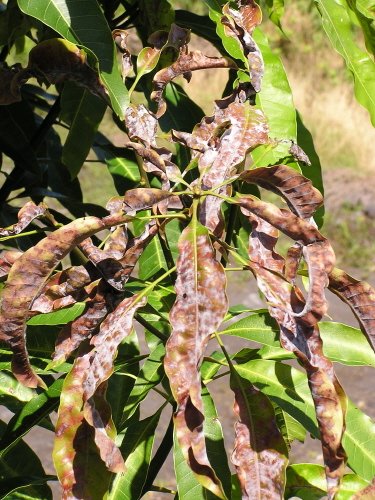
 Photo: Scot Nelson, Wayne Nishijima · Public domain · source ↗

Mango powdery mildew (Oidium mangiferae)
Mango powdery mildew, caused by Oidium mangiferae Berthet (and the closely related Pseudoidium anacardii), is one of the three major flowering-stage diseases of mango along with anthracnose (Mango Anthracnose Colletotrichum) and malformation (Mango Malformation Fusarium). Outbreaks routinely devastate flowering and fruit set in the Chittoor and YSR Kadapa mango clusters during cool nights and warm sunny days of December-February, particularly in seasons of light unseasonal rain or heavy dew. ICAR-CISH Lucknow lists it as the principal yield-limiting disease of north Indian mango orchards.
Identification and symptoms
The pathogen produces a characteristic white, powdery growth (the fungal mycelium and conidia) on inflorescences, young leaves and immature fruit. Affected panicles develop a coating of white powder over the rachis, flower stalks and individual flowers; severely affected panicles dry up and the entire inflorescence falls without setting fruit. On young leaves the fungus produces white circular patches that later turn purplish-brown and may cause defoliation. On marble-stage fruit the powdery growth causes corky russeting, fruit drop or distortion. Unlike many powdery mildews, O. mangiferae thrives even in dry conditions provided there is high relative humidity at night.
Hosts and life cycle
The fungus is restricted to Mangifera indica. Conidia are dispersed by wind and overwinter on dormant terminal buds and twig surfaces. The disease cycle is initiated when night temperatures fall to 10-15 deg C with relative humidity above 70% and day temperatures of 20-25 deg C; conidial germination requires no free water, only ambient humidity. Generation time is 5-7 days, allowing explosive build-up during the 2-6 week panicle window. ICAR-IIHR has shown that drizzling unseasonal rain during early flowering produces the most severe outbreaks.
Damage and economic impact
ICAR-CISH and IIHR estimate yield losses of 20-80% in unmanaged orchards in severe outbreak years, with complete crop failure possible when the disease coincides with full bloom. Powdery mildew is rated by ICAR-CISH as a more serious constraint than anthracnose in north India and parts of the Rayalaseema dry belt, because it acts directly on flowers and aborts fruit set even before fertilisation.
Management
ICAR-IIHR and CISH recommend:
- Sanitation: prune and burn affected terminal shoots, dead inflorescences and mummified fruit after harvest.
- First protective spray: wettable sulphur 80% WP at 2 g/L or dinocap 48% EC at 1 ml/L immediately after panicle emergence, before flower opening. Avoid sulphur during high temperatures (above 32 deg C) and full bloom.
- Second spray: hexaconazole 5% EC at 1 ml/L or tridemorph 80% EC at 1 ml/L 10-15 days after the first spray, especially if rain or heavy dew is forecast. Tebuconazole 25% EC at 1 ml/L is also registered.
- Third spray: at marble stage if symptoms persist on fruit, with a different mode-of-action fungicide to avoid resistance.
- Cultivar selection: among major commercial cultivars, Banganapalli and Totapuri show moderate field tolerance; Neelum, Bombay Green and Mallika are highly susceptible.
- Cultural: orient orchards for free air movement; avoid late-evening sprinkler irrigation during flowering; manage canopy density (Mango Canopy Training Pruning) to reduce humid microclimate.
Related pages
See also: Mango Anthracnose Colletotrichum, Mango Malformation Fusarium, Mango Hopper Amritodus Idioscopus, Mango Flowering Management, and the major mango variety entries.
Sources
- Mango diseases. ICAR-CISH Lucknow.
- Powdery mildew of mango. ICAR-IIHR Bangalore.