 Photo: Mike Prince from Bangalore, India · CC BY 2.0 · source ↗
.jpg)
Hallikar cattle (Karnataka draught breed)
Hallikar is the most numerous of the Mysore-type draught zebu breeds and the founder breed from which Amrit Mahal, Khillari and several South Indian draught lineages descend. Registered with the ICAR National Bureau of Animal Genetic Resources (NBAGR), it is the traditional plough and cart animal of south Karnataka and is named after the Hallikar community of cattle-keepers who developed it. The Karnataka government recently declared Hallikar the official state cattle breed.
Origin and distribution
The home tract is Tumakuru, Hassan, Mysuru, Mandya, Chamarajanagara, Kolar and Chikkaballapura districts of south Karnataka. Pedigree herds are maintained at the Hallikar Research Station, Hesaraghatta, and at state breeding farms. The breed extends into adjoining parts of Tamil Nadu, where it has influenced Bargur and Kangayam, and into Andhra Pradesh in the Anantapur–Chittoor belt.
Appearance
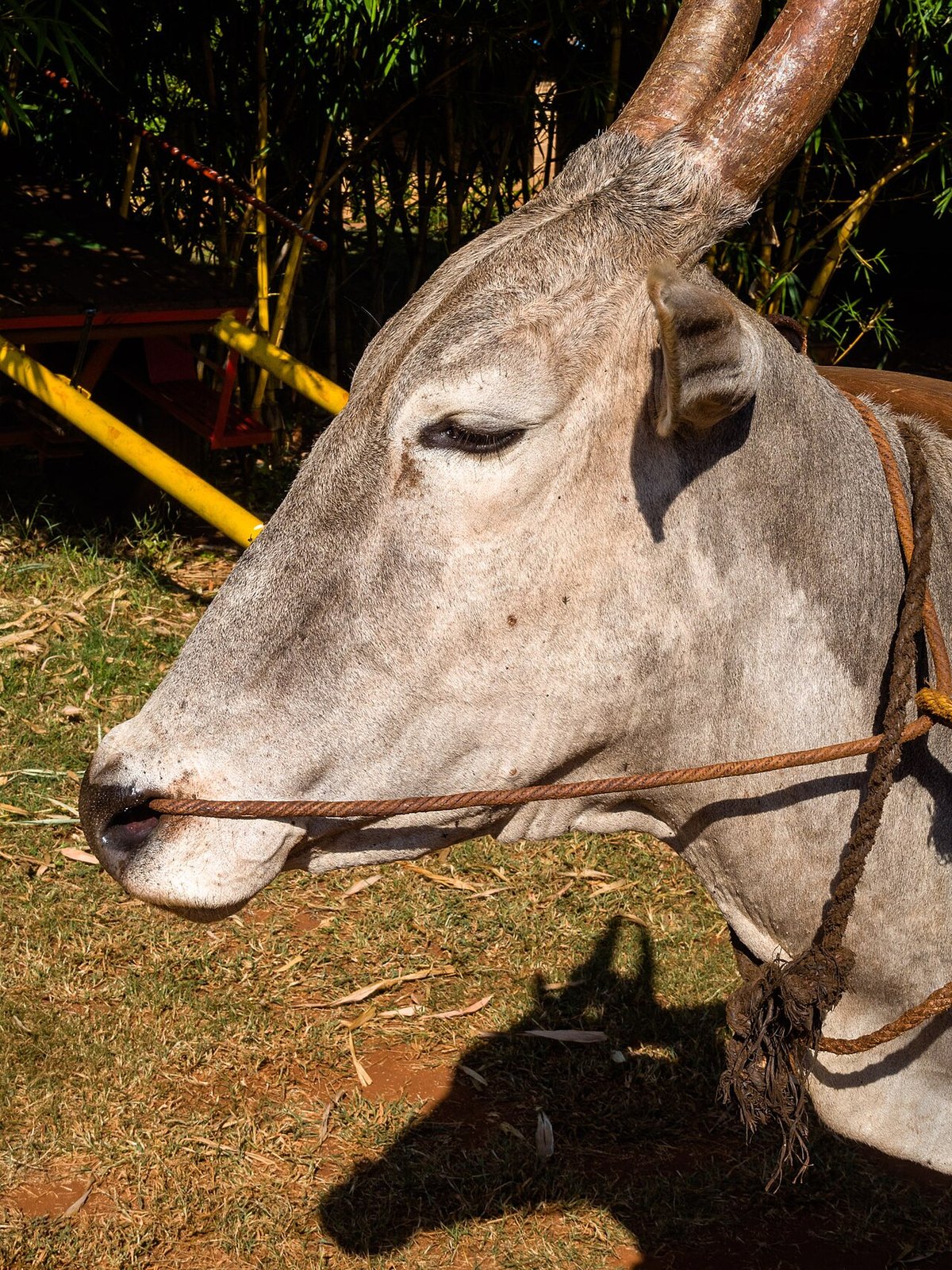
Hallikar animals are compact, muscular and medium-sized with a grey to dark-grey coat — bulls are often nearly black on the shoulders, hump and quarters. The forehead has a typical groove running down the middle. Horns are long, emerge close together and curve backward and upward in a graceful sweep, with sharp tips — a signature of the Mysore type. The hump in bulls is well developed, the dewlap is moderate and the ears are small and held horizontally. Adult cows weigh 285–320 kg and bulls 420–500 kg, with long, straight, well-tendoned legs.
Productivity
Hallikar is essentially a draught breed. Cows are modest milkers, producing 540–900 kg over a 270-day lactation, with fat at 4.5–5.0%. The breed's main value is its bullocks, which are fast, strong and untiring — they are widely used for ploughing, harrowing and inter-cultivation in rainfed ragi, jowar and groundnut tracts of south Karnataka and southern Andhra Pradesh, and for cart haulage. Pairs of Hallikar bullocks routinely complete 25–30 km of road work per day.
Management
Hallikar thrives on dryland pastures and survives on coarse fodder during drought. Standard rations are sorghum/jowar straw, finger-millet straw and seasonal green fodder, with 1.0–1.5 kg of concentrate for working bullocks on work days and 1.5–2.0 kg for milking cows. Open loose-housing or a simple thatched shed with a non-slip floor is adequate. Breeding is largely by natural service in villages; AI with progeny-tested Hallikar bull semen (Artificial Insemination Cattle) is being expanded under the Rashtriya Gokul Mission.
Related pages
See also: Amrit Mahal cattle, Bargur cattle, Kangayam cattle, Deoni cattle, Ongole cattle.
Sources
- Hallikar — NBAGR breed profile. ICAR-National Bureau of Animal Genetic Resources, Karnal.
- Hallikar — Dairy Knowledge Portal. National Dairy Development Board.