 Photo: -896856356 · ?SPRACHE=EN&BILD= 489549787. · source ↗
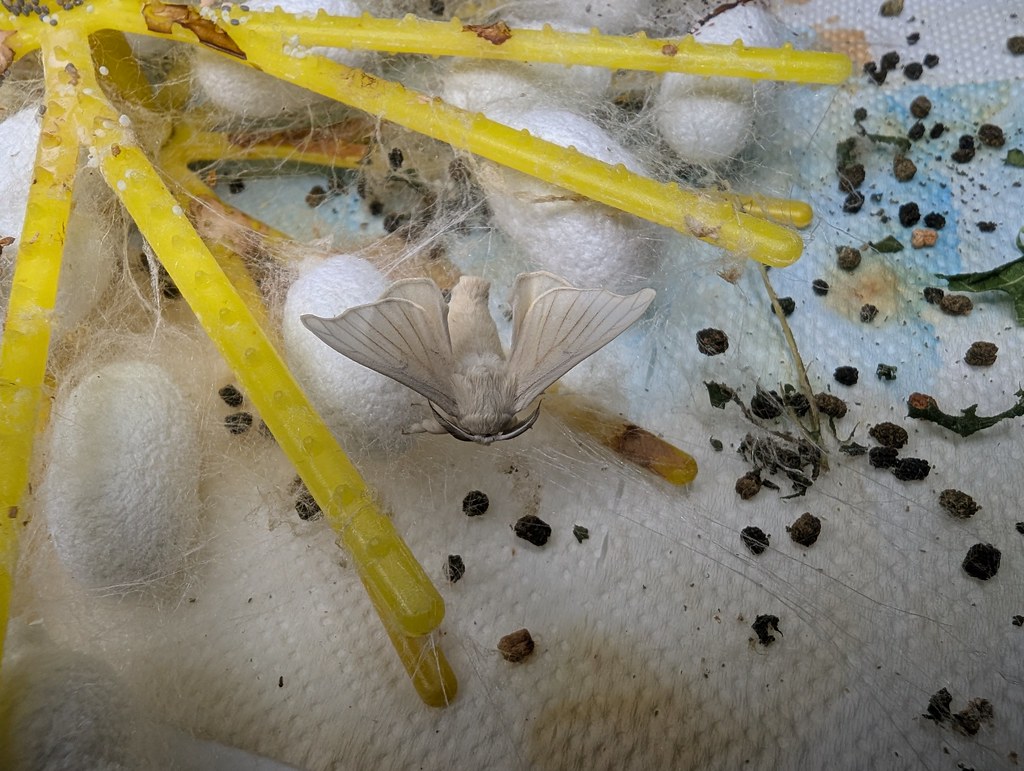
Bivoltine silkworm (Bombyx mori BV hybrid)
Bivoltine (BV) hybrids are high-yielding races of the mulberry silkworm Bombyx mori developed at the Central Sericultural Research and Training Institute (CSRTI) Mysore for tropical conditions. They were created to produce premium-quality, internationally competitive raw silk and have largely replaced the older crossbreed (CB) races in commercial sericulture in Karnataka, Andhra Pradesh, Tamil Nadu and Telangana.
Key characteristics
- Flagship hybrid: CSR2 x CSR4, with other CSR-series combinations including CSR2 x CSR5, CSR4 x CSR2 and CSR18 x CSR19
- Shell ratio: above 23%
- Raw silk recovery: 19-20%
- Cocoon yield: 70-80 kg per 100 disease-free layings (DFLs) under standard package
- Silk grade: 3A to 4A
- Larval duration: shorter and more uniform cycle than crossbreed races
Cultivation
Bivoltine hybrids require careful temperature and humidity control, certified Disease Free Layings Dfl sourced from licensed grainages, and well-grown chawki worms from a Chawki Rearing Centre. They are compatible with whole-shoot feeding (Whole Shoot Feeding), which reduces labour for leaf stripping. The hybrid is reared on V-1 or other recommended mulberry variety (Mulberry Cultivation Sericulture).
Health profile
BV hybrids are more sensitive than CB races to fluctuations in temperature, humidity and leaf quality. Strict disinfection of rearing rooms and equipment, controlled chawki rearing, and adherence to spacing and feeding schedules are essential to limit losses from grasserie, flacherie, muscardine and microsporidian infections.
Adoption and use
Cocoons spun by BV hybrids command higher reeler prices than CB cocoons in regulated auction markets such as Ramanagara (see Cocoon Marketing Csb Auction). The grade 3A-4A silk is suitable for export-quality fabric and warp yarn, supporting India's bivoltine silk programme.
Related entries
See also: Mulberry Cultivation Sericulture, Whole Shoot Feeding, Disease Free Layings Dfl, Chawki Rearing Centre, Chandrika Mountage, Cocoon Marketing Csb Auction.
References
- Species of silkworm. SILKS portal, Central Silk Board.
- Bivoltine Hybrid Breed - Cocoon Production. Journal of Innovative Research and Reviews.
- Silkworm Crop Improvement. Karnataka State Sericulture Research and Development Institute.